NVIDIA’s new NemoClaw memory-driven Chief of Staff separates durable knowledge from day-to-day judgment. Human-readable Markdown stores people, projects, priorities, and working patterns, while a SQLite ledger tracks obligations, rankings, corrections, and audit events. In NVIDIA’s Agent Memory Benchmark, the self-model design reached 90.9% overall accuracy versus 82.8% for an agentic RAG baseline.
NVIDIA is treating memory as part of the agent architecture
NVIDIA’s latest NemoClaw example starts from a simple idea: an agent becomes more useful when it can carry the right context from one workday into the next.
The company published a memory-driven “Chief of Staff” design on September 4. Instead of asking the model to reconstruct a person’s projects, priorities, collaborators, and obligations every time a new task arrives, the agent maintains a durable memory layer that can be inspected and updated over time.
That memory is not one giant conversation log. NVIDIA splits it into structures with different jobs.
The result is an agent that can remember who matters to a project, what the user has chosen to prioritize, which obligations are still active, and how previous corrections should shape later decisions. The model reasons over that context, while the surrounding runtime keeps execution inside the policies and permissions already defined for the system.
The self model lives in readable Markdown
The knowledge side of the design is intentionally easy to inspect.
NVIDIA stores the self model as human-readable Markdown pages. Those pages can represent people, projects, priorities, goals, and recurring working patterns, with indexes, cross-references, source information, and maintenance rules around the material.
That makes the memory layer look more like a small, structured knowledge base than a hidden store.
A collaborator page can record useful context about how that person works. A project page can preserve the current objective and relevant history. A priorities page can capture what the user has explicitly chosen to focus on.
Because the pages remain readable, the agent’s durable context is visible to the people operating the system. Developers can inspect what the agent believes it knows, trace where that information came from, and update the memory without having to infer everything from model behavior.
SQLite keeps the agent’s judgments separate
NVIDIA uses a different structure for information that behaves more like an evolving work queue.
A SQLite ledger stores obligations, rankings, corrections, and audit events. That separates durable knowledge from the agent’s current judgment about what deserves attention.
The distinction is practical. “Project Atlas is a current priority” is knowledge. “This message should rank third today” is a judgment. The two can influence each other, but they do not have to live in the same record.
NVIDIA’s public recipe also uses deterministic code around ranking behavior, including tier limits and ordering. The model can reason about the work, while ordinary code keeps the bookkeeping consistent.
That gives the agent a memory of its own operational decisions without rewriting source systems just to preserve those decisions.
User corrections become part of the memory loop
The design also gives user corrections a durable place to live.
If the user moves an obligation to another priority tier, ignores it, or changes how a recurring type of work should be handled, that decision can be recorded as an append-only audit event. Later runs can preserve the updated judgment instead of starting from the earlier one again.
Repeated correction patterns can also become a small, readable preference policy.
The loop is straightforward: the agent makes a judgment, the user adjusts it, the adjustment is recorded, and future runs can use that history when they face a similar situation.
That turns feedback into operating context rather than a one-time conversation. The memory becomes more useful as the user keeps working with the agent because the system can carry forward explicit decisions about priorities and working style.
Priority follows user intent, not just incoming urgency
One of the more interesting parts of the recipe is the intent gate.
Incoming messages often contain their own urgency signals, but NVIDIA’s design ranks work against the priorities the user has already expressed. A request tied directly to chosen work can move higher than a louder request that sits outside the current focus.
The public synthetic walkthrough demonstrates that behavior with email and Slack-style messages. Priority-linked items can enter the highest tier, while other items remain visible without displacing work the user has already chosen.
This is where long-term memory starts to affect agent behavior in a practical way. The agent is not only recalling facts about the user. It is using those facts to organize the next set of actions.
For a Chief of Staff-style agent, that is the difference between remembering context and actually operating with it.
The benchmark shows a clear lift on memory-heavy questions
NVIDIA also evaluated the design with an Agent Memory Benchmark built around synthetic knowledge-work corpora.
The benchmark contains 186 questions and compares the self-model approach with an agentic RAG baseline. Both configurations use NVIDIA Nemotron 3 Ultra.
NVIDIA reports 90.9% overall accuracy for the self model, compared with 82.8% for the agentic RAG baseline. On the 31 hard questions, the self model reached 87.1%, up from 67.7%.
The biggest gain came from facts that changed over time. On that slice, the self model tracked the current answer correctly on all five questions, compared with 60% for the baseline. Entity disambiguation reached 86.7%, and multisource synthesis reached 94.5%.
Those are exactly the kinds of tasks a persistent work agent needs to handle: changing project state, overlapping names, information spread across several sources, and questions that depend on what was true at a particular point in time.
NemoClaw keeps memory and execution as separate layers
The memory layer does not become the permission layer.
NVIDIA’s design uses OpenShell around the agent runtime, with sandboxing and controls over filesystem, process, and network access. Credentials for managed inference and MCP connections remain outside the agent sandbox.
That separation gives the architecture a clean shape.
Memory can say that a collaborator prefers Slack. The agent can use that information while planning a response. Actual execution still depends on the tools and permissions available to the runtime.
Persistent context helps the agent decide what makes sense to do, while the runtime still controls what the agent is allowed to do.
For developers building longer-running assistants, that separation makes memory easier to add without turning the memory store itself into an authority system.
The Upgrade Feeling
A lot of agent products talk about memory as if the goal were simply to remember more.
NVIDIA’s NemoClaw example points in a more useful direction: remember the right things in the right structure.
People, projects, priorities, and working patterns stay in readable Markdown. Obligations and corrections live in a SQLite ledger. User feedback becomes part of an audit trail. The agent can use that context across sessions, while OpenShell keeps execution governed separately.
The benchmark result is strong, but the architecture is the part worth watching.
As agents take on longer projects, memory stops being a convenience feature. It becomes part of how the agent decides what matters next.
Reasoning is moving onto the device
NVIDIA’s latest Jetson update is about a shift that would have sounded much harder a year ago: running multi-step reasoning and agentic AI locally on edge hardware.
In a technical post published September 4, NVIDIA says compact open models released through 2026 have reached a point where Jetson can run capabilities that previously belonged to much larger systems. The company uses Nemotron 3.5 Lightning and Qwen3.8-27B to show what that looks like in practice.
The goal is not just a local chatbot. NVIDIA is talking about agents that can reason through several steps, call tools, and keep working inside machines and edge applications without sending every inference request somewhere else.
That gives the story a very different feel from another model launch. The model is becoming part of the device itself.
Nemotron and Qwen take two different routes
The two models in NVIDIA’s test are built differently, which makes the comparison useful.
Nemotron 3.5 Lightning is a mixture-of-experts model with 30 billion total parameters, but only about 3 billion are active for each token. That lets the model keep a larger total parameter pool while reducing the amount of compute used on any one step.
Qwen3.8-27B takes the dense route. All 27 billion parameters participate during inference.
NVIDIA does not present one architecture as the universal answer. The point is that Jetson can now host reasoning-oriented models from more than one design family, and each one can be tuned around the workload it is meant to run.
For developers building local agents, the model choice is starting to look less like “what can fit?” and more like “which architecture fits this application best?”
For an agent, that difference can shape the entire deployment. A sparse mixture-of-experts design can keep a broad model capacity while activating a smaller slice of the network for each token. A dense model spends compute across the full network every time. Jetson now supports both paths, which gives developers more room to balance responsiveness, model behavior, and the kind of reasoning their application needs.
NVFP4 cuts the work of each inference pass
The first major optimization is NVFP4 quantization.
Instead of keeping model operations at a higher numerical precision such as BF16, NVFP4 uses a much smaller 4-bit representation on supported Jetson hardware. That reduces the memory footprint and the amount of work needed for each inference pass.
For edge devices, that is a big lever. Models that look heavy on paper become much more practical when the runtime can move less data and use lower-precision tensor operations efficiently.
NVIDIA pairs that quantization with prebuilt checkpoints and optimized serving through vLLM. The Jetson AI Lab model catalog already lists Nemotron 3.5 Lightning and Qwen3.8-27B with platform-specific run options, so this is not only a benchmark recipe hidden inside a research post.
Developers can start from an existing optimized configuration and then measure it against the prompts their own application will actually use.
Speculative decoding adds another layer of speed
Quantization is only half of NVIDIA’s performance story.
The second technique is speculative decoding. A smaller draft process proposes several tokens ahead of time, and the main model verifies them. When enough of those proposed tokens are accepted, the system can produce multiple output tokens for the cost of fewer full-model verification steps.
NVIDIA tested several speculative-decoding methods rather than assuming one would win everywhere. Nemotron 3.5 Lightning performed best with DSpark in the company’s tests, while Qwen3.8-27B performed best with DFlash2.
That distinction is useful. The fastest setup is not simply “turn on speculative decoding.” The draft method and checkpoint have to match the model and the workload.
Combined with NVFP4, speculative decoding pushed the best Jetson configuration in NVIDIA’s tests to as much as 6.28× the decode throughput of the BF16 baseline.
That 6.28× number is a peak, not a universal constant
The headline number is strong, but NVIDIA’s own measurements make the more useful point: inference speed depends on what the agent is doing.
The company kept the fastest speculative-decoding configuration for each model and tested writing, reasoning, summarization, and retrieval-augmented generation workloads. Throughput moved between categories even when the model and decoding method stayed the same.
Nemotron 3.5 Lightning with DSpark ranged from 123.01 to 138.02 output tokens per second. Qwen3.8-27B with DFlash2 ranged from 27.69 to 34.44 output tokens per second.
That is why NVIDIA recommends testing with representative prompts instead of treating a general benchmark as the final answer.
For an edge agent, the practical target is not the largest number on a chart. It is the configuration that stays fast on the exact mix of reasoning, retrieval, tool use, and response generation the device will perform.
Local reasoning changes what edge systems can do
Once reasoning models can stay on the device, the list of possible applications gets much more interesting.
NVIDIA points to in-cab assistants, real-time anomaly detection, and robots operating in remote or demanding environments. These are systems where the AI is close to the sensors, machines, and people it is helping.
A local agent can inspect incoming data, reason through a situation, and act without turning every step into a round trip to a remote service. That is especially useful when the agent is part of a physical workflow rather than a browser tab.
The same idea applies to robotics. A robot that can run a reasoning model onboard has a different relationship with its environment: perception, planning, tool use, and response can stay closer to the machine.
Jetson has been moving in that direction for years. The difference now is the kind of model NVIDIA says can fit into that local loop.
The edge setting also changes what counts as useful latency. A machine reading cameras, microphones, telemetry, or industrial sensors may need to reason close to the moment the data arrives. Keeping the model on the same system means the AI can sit directly inside that loop. The result can be an assistant that responds to the current state of a vehicle, a robot that reasons over what its sensors are seeing, or an industrial agent that combines local signals before deciding what to do next.
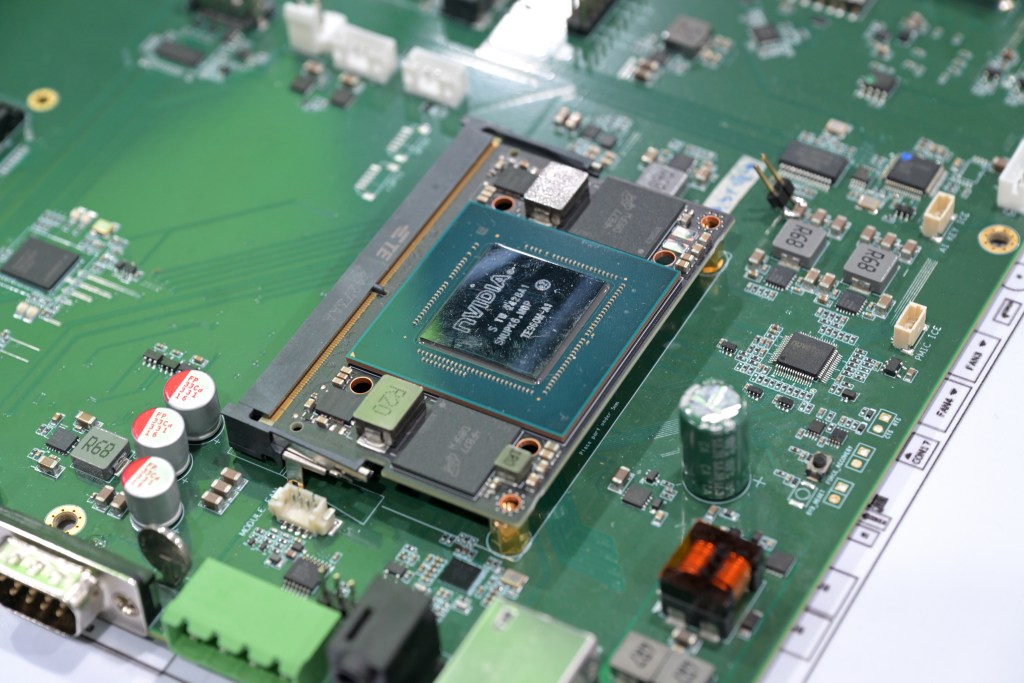
Jetson AI Lab is turning the research into runnable recipes
NVIDIA is also making the deployment path unusually concrete.
The Jetson AI Lab model catalog lists supported models by Jetson platform and inference engine, with quick-start commands for models including Nemotron 3.5 Lightning and Qwen3.8-27B. Developers can see which Jetson modules are supported, choose an inference runtime, and generate a launch command from the page.
That closes an important gap between a performance blog and something a developer can reproduce.
The technical post also links to tutorials for running LLMs and VLMs on Jetson, benchmarking generative AI models, and getting started with speculative decoding. The message is clear: NVIDIA wants local reasoning to be a deployable developer workflow, not a one-off demonstration.
As the model catalog grows, the edge is starting to look less like a place where only tiny models run and more like another serious target for agentic AI.
The Upgrade Feeling
The most interesting part of NVIDIA’s Jetson update is not that one benchmark got faster.
It is that local reasoning is starting to feel normal.
Nemotron 3.5 Lightning can activate only a fraction of its total parameters per token. Qwen3.8-27B shows a dense model can live in the same edge conversation. NVFP4 cuts the work of each pass, speculative decoding pushes more tokens through, and Jetson AI Lab turns those pieces into something developers can actually run.
That combination changes the shape of the edge. Instead of treating the device as a sensor that hands intelligence off somewhere else, the device can increasingly keep the reasoning loop with it.
For robotics, industrial systems, and local AI agents, that is a much bigger upgrade than another raw model score.
NVIDIA Is Bringing the Open Model Hub Into Its AI Platform
NVIDIA announced on September 3, 2026 that it has agreed to acquire Hugging Face. The announcement immediately connects two very different but highly complementary parts of modern AI development. NVIDIA builds the accelerated computing platforms used across training, inference, graphics, robotics, and large-scale AI infrastructure. Hugging Face has become a central place where developers discover models, datasets, applications, libraries, and deployment options. NVIDIA’s stated goal is to scale the Hugging Face platform, strengthen its infrastructure, and expand access to AI for developers and institutions around the world.
Hugging Face Has Become One of AI’s Main Discovery Layers
The scale NVIDIA highlighted helps explain why this deal matters to developers. According to NVIDIA’s announcement, more than 18 million developers, researchers, and creators use Hugging Face. The platform hosts more than 3 million models, around 500,000 datasets, and about 1 million applications, while more than 200,000 companies use the platform to discover, evaluate, customize, and deploy AI. Those numbers make Hugging Face more than a repository. It acts as a discovery layer across the open-model ecosystem, connecting model creators, application builders, inference providers, researchers, and organizations in one shared environment.
The Most Important Promise Is That the Hub Stays Open
NVIDIA’s announcement makes openness a central part of the acquisition. The company says Hugging Face will remain an open platform for the entire AI ecosystem. Developers will continue choosing the models they want, the frameworks they want, the cloud platforms they want, the inference service providers they want, and the computing platforms they want. NVIDIA goes one step further and says NVIDIA compute will not be required to build on or deploy through Hugging Face. That statement preserves one of the Hub’s defining characteristics: it is designed to connect many models, tools, and providers rather than force every workflow into one stack.
Model Choice Remains at the Center of the Experience
Hugging Face’s own documentation describes the Hub as a reference platform for open machine learning and as a collaboration layer for models, datasets, and applications. Model repositories can contain weights, configuration files, documentation, evaluation information, and version history. Developers can browse, compare, download, fine-tune, and integrate models using a wide range of libraries. NVIDIA’s commitment to preserve model choice means this workflow is expected to remain broad. A developer can continue selecting the model that fits the task rather than treating the platform as a catalog tied to one model family.
Framework Choice Is Part of the Same Open Design
Modern AI development rarely uses one framework for every job. Teams move between Transformers, PyTorch-based workflows, optimized inference runtimes, local engines, orchestration tools, and custom application code. NVIDIA explicitly says developers will continue choosing their preferred frameworks on Hugging Face. That is important because the Hub has grown partly by serving as a common meeting point between many software ecosystems. A model can live in one repository while being discovered, tested, downloaded, or deployed through different tools. Keeping that flexibility gives the combined platform room to support many different development styles.
Cloud Choice Also Remains Flexible
NVIDIA’s statement also preserves cloud choice. Hugging Face already supports dedicated endpoints and deployment workflows across different infrastructure environments, and its documentation describes the Hub as a collaboration layer rather than a single-cloud destination. That flexibility matters because AI teams often choose deployment environments based on workload, geography, scale, organizational requirements, or existing architecture. NVIDIA’s announcement says those choices will remain available after the acquisition, keeping the Hub positioned as a common layer that can connect models to multiple infrastructure paths.
Inference Provider Choice Is Especially Important
Hugging Face’s Inference Providers system already gives developers one interface for running models through a broad set of serverless inference partners. Its current documentation lists providers including Cerebras, Cohere, DeepInfra, fal, Fireworks, Groq, Replicate, Scaleway, Together, and others alongside Hugging Face’s own inference services. Developers can use the Hugging Face SDK with a selected provider or let the client route automatically. NVIDIA’s promise that inference-provider choice will continue is therefore directly connected to a major part of the Hub’s current design.
The Hub Is More Than a Model Download Page
Hugging Face repositories are Git-based and support versioning, commit history, diffs, branches, collaboration, and integrations. The platform also hosts datasets and Spaces, giving developers a way to move from a model file to evaluation data, demonstrations, applications, and interactive experiments without leaving the same ecosystem. That broader structure is one reason the acquisition reaches beyond model hosting. NVIDIA is not only gaining a catalog of weights. It is bringing a large developer workflow, collaboration surface, and model-discovery network closer to its own AI software and infrastructure ecosystem.
Datasets Are a Major Part of the Platform
Datasets are another important layer. Hugging Face’s documentation describes datasets on the Hub as repositories that can include training, evaluation, and testing data together with Dataset Cards and browser-based viewers. Developers can search by task, language, license, and other attributes, then access datasets through the Hub or programmatically through the datasets library. NVIDIA’s acquisition therefore connects compute not only to finished models, but also to the data workflows used to evaluate, adapt, and build AI systems. That gives the combined ecosystem a wider development surface from experimentation through deployment.
Spaces Turn Models Into Working Applications
Hugging Face Spaces add an application layer on top of the Hub. Developers can build interactive demos with Gradio, Docker, or static HTML, link models and datasets, and publish working AI experiences that other users can test directly in the browser. This turns model discovery into something more tangible. Instead of only reading a model card, a user can often interact with an application built around the model. In the context of NVIDIA’s acquisition, Spaces give the platform a visible application layer that sits between model repositories and full production deployment.
NVIDIA Already Works With Hugging Face Models Today
The two ecosystems are already connected technically. NVIDIA’s NIM documentation includes Hugging Face as a model source, using Hugging Face repository identifiers and tokens when needed. NVIDIA NeMo Platform documentation also describes workflows for deploying supported Hugging Face models. That means the acquisition is not starting from zero integration. Developers already move models between Hugging Face repositories and NVIDIA deployment tooling. Bringing the organizations together can make those paths easier to coordinate while the Hub continues supporting other infrastructure options.
The Combination Connects Discovery With Accelerated Deployment
One of the clearest opportunities is the connection between discovering a model and running it efficiently. Hugging Face is where many developers begin: search for a model, inspect the model card, compare alternatives, test an application, download weights, or call an inference provider. NVIDIA’s software stack begins to matter when teams want accelerated training, optimized inference, or larger-scale deployment. Bringing those layers closer creates a more continuous path from finding a model to experimenting with it and then moving into optimized production infrastructure when that is the right fit.
Open Models Can Reach More Production Paths
Hugging Face’s current inference architecture already supports several routes: hosted inference providers, managed endpoints, and local endpoints such as llama.cpp, Ollama, vLLM, LiteLLM, and Text Generation Inference. NVIDIA’s announcement says those kinds of choices will remain open. That means the Hub can continue serving as a model layer that feeds many production paths. NVIDIA can add stronger integrations and infrastructure around its own stack without removing the broader routing model that developers already use.
The Developer Experience Is the Real Center of the Deal
The announcement is easy to describe as a connection between a hardware company and a model platform, but the developer workflow is the more useful lens. Hugging Face sits where developers search, compare, evaluate, share, and collaborate. NVIDIA sits where many teams optimize and scale AI workloads. The value of the combination comes from reducing the distance between those activities. A developer can begin with an open model, evaluate it, test it in an application, choose an inference path, and move toward deployment while staying inside a connected ecosystem.
Hugging Face Keeps Its Role as a Multi-Provider Layer
The most distinctive part of NVIDIA’s announcement is that Hugging Face is expected to continue supporting many providers rather than becoming an NVIDIA-only front end. Developers can keep choosing cloud platforms, inference services, frameworks, and compute. That preserves the Hub’s usefulness as neutral connective tissue across AI workflows. NVIDIA can still improve integration with its own software and infrastructure, but the platform can remain valuable to developers who use different hardware or deployment environments.
NVIDIA Gets Closer to Where Model Decisions Begin
Most infrastructure decisions happen after a team has already chosen or narrowed down a model. Hugging Face sits much earlier in that process. Developers use the Hub to discover what exists, inspect how a model was built, compare versions, read documentation, test demos, and identify compatible deployment options. By acquiring Hugging Face, NVIDIA moves closer to that starting point. It gains a direct connection to the layer where millions of developers begin deciding what models and tools they want to use.
Hugging Face Gets a Larger Infrastructure Partner
NVIDIA’s stated plan is to scale Hugging Face’s platform and strengthen its infrastructure. For a service hosting millions of AI artifacts and serving developers around the world, infrastructure is a central part of the product experience. Faster access, stronger deployment paths, larger-scale services, and deeper optimization can all make the Hub more useful as model sizes and application demands grow. NVIDIA’s accelerated computing experience gives the combined organization a substantial technical foundation for expanding those capabilities.
The Open Model Ecosystem Becomes More Connected
AI development is increasingly distributed across model creators, dataset builders, application developers, cloud platforms, inference services, local runtimes, and hardware vendors. Hugging Face already connects many of those pieces. NVIDIA adds another large layer of infrastructure and software to that network. If the company follows the open-platform commitments in its announcement, the result can be a more connected ecosystem where developers keep choosing their tools while gaining more direct paths into accelerated infrastructure when they need it.
This Is a Platform Story More Than a Hardware Story
NVIDIA is best known for accelerated computing, but this acquisition is fundamentally about software distribution and developer access. Hugging Face is one of the places where open models become discoverable, testable, shareable, and deployable. That makes the deal important even for developers who are not thinking about GPUs at the moment they open the Hub. The strategic connection is between the place where AI assets are organized and the infrastructure that can help run them at scale.
The Upgrade Feeling
The biggest idea here is not that NVIDIA now owns another AI company. It is that the company is moving closer to one of the main places where developers discover and use open models. Hugging Face brings the models, datasets, apps, repositories, collaboration tools, and provider connections. NVIDIA brings accelerated infrastructure and a large software stack built around AI deployment. The most encouraging part of the announcement is the promise that the Hub will remain open and multi-provider. If that stays true in practice, developers gain a tighter bridge between open-model discovery and production-scale AI without giving up the choices that made Hugging Face useful in the first place.
NVIDIA PAIR is a free, open-source virtual inference router that helps compatible computers on the same local network share independent AI inference workloads through one familiar local interface.
The Short Version
NVIDIA PAIR is a new open-source virtual inference router built to help people use several compatible computers on the same local network for local AI. Instead of sending every independent inference job to one machine, PAIR can discover participating systems, check which models and engines are available, and route work to an eligible computer. The result is a cleaner way to make more of the AI hardware already available at home or in a personal workspace.
A New Layer for Personal AI
Personal AI is quickly moving beyond one chat window and one model call at a time. Developers and power users are now running research agents, coding agents, organization tools and multiple local sessions at once. PAIR gives that growing activity a shared routing layer. Applications can continue using familiar local interfaces while PAIR handles where each independent request should run across the available machines.
PAIR Works With Familiar Local AI Engines
NVIDIA designed PAIR to work with existing local inference services rather than asking users to rebuild their software stack. The beta supports Ollama and LM Studio, two widely used tools for running models locally. PAIR sits in front of those engines and presents compatible proxy endpoints, giving applications a familiar connection while the routing layer manages placement across participating systems.
One Local Endpoint, Multiple Compute Options
From the application’s point of view, the workflow stays simple. A request arrives through the local endpoint, PAIR identifies the engine and model it needs, and then selects an eligible node. The application keeps seeing one connection while the routing happens behind the scenes. This is an elegant approach because it adds flexibility without forcing every agent or desktop tool to learn a completely new cluster interface.
Independent AI Jobs Can Run Across Different Machines
PAIR is especially useful when a workload creates several independent inference requests. A lead agent can assign research, coding, verification and summarization jobs to different subagents, and PAIR can place those requests on different available systems. That opens the door to more parallel local AI activity using hardware that might otherwise be sitting unused.
The Same Model Can Be Available on Several Nodes
Users can prepare the same model on multiple participating machines. When several nodes have that model available, PAIR has more eligible places to route incoming requests. This creates a simple way to expand service capacity for the models a user runs most often, especially in workflows where many agents may call the same model during one larger task.
Different Machines Can Host Different Models
PAIR also supports a more specialized setup. One computer can host one set of models while another holds a different set. The router checks model availability as part of its placement decision, allowing a personal AI network to become more organized. A workstation can be prepared for one class of workload while another system is ready for a different model or task.
PAIR Discovers Systems on the Local Network
The software uses local-network discovery through mDNS to find nearby compatible systems. Users can also add a node manually by IP address. Once the desired computers are paired, PAIR can treat them as part of the same trusted local group and keep track of which systems are currently ready to contribute AI capacity.
Pairing Is Designed to Be Simple
Connecting machines starts with a six-digit pairing PIN. After the pairing step, PAIR establishes certificate-based trust between cluster members. NVIDIA combines this straightforward setup flow with mutual TLS for most peer communication, giving the local cluster a secure foundation without turning setup into a complex infrastructure project.
The Scheduler Watches the State of Each Node
PAIR continuously tracks useful routing signals across participating systems. It checks whether a node is online and ready, whether the required inference engine is enabled, whether the requested model is present, the amount of queued work, and GPU utilization. These signals help the router choose an available destination for each new independent request.
Home Hardware Can Join and Leave Dynamically
One of PAIR’s most practical ideas is elastic participation. A compatible laptop, gaming PC, workstation or DGX Spark can contribute capacity while it is available and then simply leave the active pool when it is powered down or moved elsewhere. That makes PAIR a natural fit for real personal hardware, where devices are used for many different things throughout the day.
Support Starts With GeForce RTX 20 Series and Newer
NVIDIA says the PAIR beta supports systems with GeForce RTX 20 Series GPUs and newer. It also supports NVIDIA RTX PRO workstation GPUs based on Turing or newer architectures and NVIDIA DGX Spark. That gives the beta access to a broad range of existing RTX hardware rather than focusing only on the newest desktop systems.
Apple M4 and Newer Systems Are Included
The supported-hardware list also includes Apple M4 or newer silicon. That cross-platform support makes the concept especially interesting for users who already have a mixed collection of computers. PAIR can provide one routing layer across compatible systems even when those systems are not all built around the same desktop platform.
Windows, Linux and macOS Are Supported
The beta is available for supported Windows, Linux and macOS systems. NVIDIA provides both graphical and terminal interfaces, so PAIR can fit desktop workflows as well as more technical setups. The terminal option also makes it practical to include machines that are used primarily as compute nodes.
NVIDIA Demonstrated a Major Multi-Agent Speedup
NVIDIA demonstrated PAIR with a five-subagent workload using Hermes Desktop and Ollama. In the company’s test, the workload completed in 18 minutes on a single RTX Spark laptop. With a three-device PAIR cluster, it completed in 8 minutes and 48 seconds. The demo gives a concrete example of how parallel local AI requests can benefit when more compatible systems are available to serve them.
Multi-Agent Workflows Are a Natural Match
Agent systems naturally create the kind of workload PAIR is designed to organize. A lead agent can delegate separate tasks to specialized subagents, and those subagents can produce many model calls during one larger job. PAIR gives those independent calls more places to run, turning a collection of local computers into a more coordinated environment for agentic AI.
Research Agents Can Spread Work Across the Network
A research workflow can divide a topic into several branches, ask different subagents to collect evidence, and then bring the results together. With PAIR, those independent inference requests can be routed across multiple available systems. This is a strong example of how personal AI can move from a single-machine workflow toward a more flexible local compute network.
Coding Agents Can Benefit From More Available Capacity
Coding assistants increasingly combine planning, code generation, testing, review and documentation. When those activities are handled by several subagents, the number of local model calls can grow quickly. PAIR gives developers a way to bring additional computers into that workflow while keeping the application connected through a familiar local interface.
The Main PC Can Stay Focused on the User
PAIR can also help users make better use of a second PC or workstation while keeping the primary computer focused on interactive work. New inference jobs can be routed toward another eligible system with available capacity. For people who already own several capable machines, that makes local AI feel less tied to whichever computer happens to be in front of them.
Local-First Architecture Keeps the Experience Close to Home
NVIDIA designed PAIR around local-network operation. Participating systems discover one another on the LAN, and the routing layer is built to keep prompts, data and inference traffic within the user’s local environment when the local application and inference stack are configured that way. This fits neatly with the appeal of local AI: more direct control over where personal compute runs.
Mutual TLS Protects Most Peer Communication
After systems are paired, PAIR uses certificate trust and mutual TLS for most communication between cluster members. That gives the local compute group authenticated connections between participating nodes while keeping the overall setup approachable for personal use. Security is integrated into the pairing and routing design rather than being left as a separate manual project.
Getting Started Follows a Familiar Local-AI Flow
The setup process is straightforward: install PAIR on the participating computers, discover or add the systems, pair them, enable a supported inference engine, and prepare the models needed by the workload. Compatible applications can then connect through PAIR’s local endpoint. The structure feels close to a normal local-AI setup, with the routing layer adding access to more machines.
PAIR Can Help Install Engines and Prepare Models
NVIDIA’s getting-started documentation says PAIR can help install and start supported inference engines and initiate model downloads on participating nodes. That makes it more than a passive traffic layer. It can also help users prepare the machines that will provide local inference capacity, reducing some of the repetitive setup work across a multi-computer environment.
Open Source Gives Developers a Clear View of the Project
NVIDIA released Personal AI Router as an open-source project under the Apache License 2.0. Developers can inspect the code, study the architecture, report issues and contribute improvements. For a tool that coordinates AI work across several personal machines, that openness is valuable because the routing logic and project direction are visible to the community.
PAIR Creates a Home Inference Fabric
The clearest way to think about PAIR is as a home inference fabric. One local entry point can coordinate independent AI jobs across several available systems. Applications keep using familiar interfaces while the router handles placement. This creates a clean bridge between today’s local model tools and a future where personal AI regularly uses more than one computer.
Personal AI Is Expanding From One Session to Many
PAIR arrives at a useful moment. Local AI is expanding from one user talking to one model toward multiple agents and background sessions working at the same time. As that pattern grows, the ability to coordinate several computers becomes increasingly useful. PAIR gives NVIDIA users an early look at what a more distributed personal AI environment can feel like.
Who Will Get the Most From PAIR
PAIR is especially appealing for AI enthusiasts, developers, creators and power users who already own more than one capable computer. It also fits people experimenting with local research agents, coding agents, personal automation and multi-agent workflows. The more independent AI jobs a workflow creates, the more useful an organized pool of local compute can become.
Why This Launch Matters
PAIR makes spare local AI capacity easier to use. It connects familiar inference engines, familiar application interfaces and existing personal hardware through one open-source routing layer. That is a meaningful step because it makes multi-computer local AI feel more like a normal desktop capability and less like a specialized infrastructure project.
The Upgrade Feeling
NVIDIA PAIR has a simple but powerful idea behind it: the computers already around you can work together more intelligently for local AI. A gaming PC, workstation, laptop or DGX Spark can become part of the same personal inference network, with PAIR deciding where independent jobs should run. For multi-agent workflows, that turns existing hardware into a more flexible and coordinated AI environment — exactly the kind of upgrade that can change how personal compute feels in everyday use.
NVIDIA PAIR turns compatible computers on the same local network into a shared inference pool for AI apps and agents. It does not merge GPU memory or split one model across machines. Instead, PAIR discovers eligible Windows, Linux and macOS systems, tracks whether Ollama or LM Studio is ready, checks whether the requested model is present and routes each independent inference request to one available node. That architecture is especially useful for multi-agent workflows where several subagents make model calls at the same time. In NVIDIA’s configuration-specific Hermes demo, a three-device PAIR cluster completed a five-subagent workload in 8 minutes 48 seconds versus 18 minutes on one RTX Spark laptop. The more important shift is that local AI is starting to become distributed software: the gaming PC, workstation and laptop already in a home can act as separate workers behind one local endpoint.
Your Second PC Just Became an AI Worker
Local AI usually begins with one machine.
One GPU.
One inference server.
One model queue.
That works until the agent stops behaving like a chatbot.
A multi-agent system can create several model calls at once.
One subagent researches.
Another checks documents.
Another verifies an answer.
Another writes code.
Another summarizes the result.
If every request targets the same GPU, the jobs queue behind one another while another capable PC in the house may be doing nothing.
NVIDIA PAIR is designed around that mismatch.
It turns several compatible computers on one local network into a shared pool for independent AI inference jobs.
PAIR Was Announced at IFA 2026
NVIDIA announced Personal AI Router, or PAIR, on September 3, 2026 as part of its IFA push around local agents.
The software is available in beta for supported Windows, Linux and macOS systems.
NVIDIA describes it as a free, open-source virtual inference router.
PAIR works with Ollama and LM Studio at launch.
The goal is to let existing AI applications keep talking to a familiar local endpoint while PAIR decides which participating machine should actually run each request.
That is a software-routing problem more than a new model problem.
PAIR Is Not a New Inference Engine
This distinction is important.
PAIR does not replace Ollama.
It does not replace LM Studio.
It does not execute the model itself.
A supported inference engine still loads and runs the model on the selected computer.
PAIR sits in front of those engines.
It discovers machines.
Tracks their readiness.
Checks model availability.
Routes requests.
Then returns the response to the application that made the call.
The agent sees one local service.
PAIR handles placement behind it.
One Endpoint Hides Several Machines
The abstraction is simple.
An AI application connects to a local endpoint.
PAIR presents Ollama-compatible and OpenAI-compatible proxy interfaces.
The application sends a request as if it were talking to one local engine.
PAIR reads the engine and model requirements, chooses one eligible node, forwards the request and streams the answer back.
The application does not need to discover every machine itself.
That is the part that makes the cluster usable.
The complexity moves from the agent into the router.
The Devices Stay Separate
NVIDIA uses the phrase personal AI cluster.
That can create the wrong mental picture.
PAIR does not fuse several PCs into one giant computer.
Each device remains an independent machine.
Each GPU keeps its own memory.
Each inference engine keeps its own model files.
PAIR simply sends different independent requests to different systems.
That distinction defines what PAIR can accelerate and what it cannot.
PAIR Does Not Pool VRAM
Two 24 GB GPUs do not become one 48 GB GPU through PAIR.
NVIDIA explicitly says PAIR does not combine GPUs into a larger logical accelerator.
It does not pool VRAM.
If a model requires more memory than one machine can provide, PAIR cannot make that model fit by borrowing memory from another node.
The full model still has to fit on the individual computer selected to run the request.
That makes PAIR a routing layer, not distributed tensor-parallel inference.
PAIR Does Not Shard One Model Across Machines
The same rule applies to model execution.
PAIR does not split one inference request across several computers.
One request goes to one eligible node and stays there for its lifetime.
Another independent request can go to a different node.
That means the gain comes from concurrency.
Many calls at once.
Not one giant call spread across many GPUs.
This is why multi-agent workflows are the natural target.
Agents Create Exactly the Kind of Work PAIR Can Parallelize
A single chatbot conversation is often sequential.
Prompt.
Answer.
Next prompt.
An agentic workflow can be much wider.
A lead agent decomposes one task into several independent jobs.
Those jobs can run at the same time.
Each one may trigger its own inference request.
That is where a single local GPU becomes a queue.
PAIR gives the inference layer the same parallel structure as the agent workflow.
Several subagents can make progress simultaneously on different machines.
NVIDIA’s Demo Cut One Five-Agent Workload From 18 Minutes to 8:48
NVIDIA demonstrated PAIR with Hermes Desktop and Ollama.
Hermes created five specialist subagents for a synthetic household-inbox task.
On one RTX Spark laptop using Qwen 3.6 35B A3B, NVIDIA says the workload took 18 minutes on average.
A three-device PAIR cluster containing an RTX Spark laptop, a DGX Spark and an RTX 5090 desktop completed the same workload in 8 minutes 48 seconds on average.
That is a large difference.
It is also not a universal benchmark.
The 8:48 Result Has a Big Asterisk
NVIDIA explicitly labels the demonstration unofficial and configuration-specific.
The result depends on how parallel the workload is.
Which model is running.
The inference-engine configuration.
The hardware mix.
Network conditions.
Whether nodes are available.
A different task can scale differently.
A sequential workflow may gain almost nothing.
So the correct conclusion is not “PAIR makes AI twice as fast.”
The demo shows that routing independent calls across several ready devices can reduce queueing substantially when the workload exposes enough parallel work.
PAIR Watches Which Machines Are Actually Available
A home cluster is not a datacenter.
A laptop closes.
A gaming PC becomes busy.
A workstation goes to sleep.
A machine may have the right inference engine but not the requested model.
PAIR is designed around that instability.
It maintains a live view of the participating systems and decides whether each one can accept a new request.
The available pool can change while the cluster is running.
The Scheduler Checks More Than Whether a PC Is Online
NVIDIA says PAIR currently considers several factors for each request.
Is the paired node online and ready?
Is the required inference engine enabled?
Is the exact requested model present?
How many jobs are already active?
Is the GPU busy with another graphics-intensive workload?
Those signals let the router avoid sending work blindly.
A connected machine is not automatically an eligible machine.
Your Gaming PC Can Leave the Pool When You Need It
This is one of the more practical design choices.
A gaming PC may be an excellent AI worker while nobody is using it.
Then a game launches.
GPU utilization rises.
The machine should stop behaving like spare inference capacity.
PAIR can route new requests elsewhere when another system is more appropriate.
The same logic applies when a laptop sleeps or leaves the network.
Local AI capacity becomes elastic instead of permanently reserved.
The Requested Model Still Has to Exist Somewhere
PAIR cannot route a model request to a machine that cannot serve it.
The inference engine has to be running.
The model has to be available on that node.
The hardware has to have enough memory to load it.
That creates an important operational detail.
If only one computer has a particular model, every request for that model will still converge on that one machine.
The cluster only becomes useful for that workload when several eligible nodes can serve the requests.
Every Node Does Not Need the Same Model Library
The opposite is also true.
NVIDIA says machines in a PAIR cluster do not have to hold identical model collections.
One system can host one model.
Another can host a different model.
PAIR can route requests according to where the requested model exists.
Replicating the same model across several nodes increases the number of machines that can serve that request.
Different model placement can turn the home cluster into a small heterogeneous inference pool.
That Makes Storage Part of Local AI Scaling
Distributed inference sounds like a GPU story.
It is also a storage story.
If the same large model is copied to three machines so all three can answer requests, the model consumes storage three times.
Local agents may use several models.
Embedding models.
Language models.
Vision models.
Rerankers.
The more redundancy a user wants across the cluster, the more local disk capacity is consumed.
PAIR does not eliminate that trade-off.
It makes the trade-off manageable through routing.
PAIR Supports RTX 20 Series and Newer
NVIDIA says the beta supports GeForce RTX 20 Series GPUs and newer.
RTX PRO workstation GPUs using Turing architecture and newer are also included.
DGX Spark is supported.
That gives PAIR access to hardware accumulated across several generations rather than requiring only the latest flagship card.
A household may already own much of the compute before installing the software.
That is central to the pitch:
use the machines that are already there.
Apple M4 and Newer Can Join Too
The most interesting compatibility decision may be Apple silicon.
NVIDIA says PAIR supports Macs with M4 or newer silicon.
That means the personal cluster is not limited to NVIDIA-only client hardware.
A Windows RTX desktop and a supported Mac can participate in the same routing system.
The inference engine and model still have to work on the node.
But the router itself is designed around mixed operating systems and mixed hardware.
That makes PAIR closer to a software-defined home inference layer than an RTX-only cluster manager.
Windows, Linux and macOS Nodes Can Mix
PAIR supports Windows 11, Linux and macOS.
The open-source repository says x64 and arm64 are supported across the three operating-system families, with Windows on Arm marked experimental.
Nodes using different operating systems can be paired together.
That flexibility matters because personal hardware is messy.
One person may have a gaming desktop on Windows, a Linux workstation and a MacBook.
PAIR is designed to treat that mixture as potential inference capacity rather than forcing the user to standardize the entire household.
Ollama and LM Studio Are the First Backends
At launch, PAIR supports Ollama and LM Studio.
That choice lowers integration friction.
Both are already widely used for local model inference.
Applications that already know how to talk to those local interfaces do not need a custom distributed-computing API.
PAIR proxies the familiar interface instead.
NVIDIA says agent harness changes are not required for compatible workflows.
That is strategically important.
A new router is much easier to adopt when users do not also have to replace the tools around it.
The Router Can Discover Machines Automatically
PAIR uses local-network discovery through mDNS to find nearby participating systems.
A node can also be added by IP address.
The user then approves a pairing request.
The goal is to make adding compute closer to connecting a local device than configuring a traditional compute cluster.
That matters because the target environment is not an enterprise datacenter run by cluster administrators.
It is a home, studio or small workstation network.
The Pairing Layer Uses mTLS
NVIDIA says node-to-node communication is blocked until pairing is established.
After pairing, communications use mutual TLS with generated certificates.
That provides encrypted traffic and authentication between cluster members.
The security model still depends on the local environment.
NVIDIA’s repository explicitly warns users to read the security documentation before deploying PAIR on an untrusted or shared network.
A local network is not automatically a trusted network.
Local Does Not Automatically Mean Every Byte Stays Private
NVIDIA describes PAIR as designed for private local inference.
Prompts, files and agent context can remain on the home network rather than going to a cloud inference service.
The open-source repository adds an important qualifier.
That statement holds when the configured client, model source, inference engine and participating nodes are all local.
An agent can still choose to call a cloud service.
An application can still transmit data elsewhere.
PAIR keeps its routing local.
It cannot guarantee the behavior of every other component in the workflow.
No Internet Is Required for Operation
NVIDIA’s PAIR product page says internet connectivity is not required for operation.
Internet access is required for downloading models.
Once the needed software and model files are present, the routing layer can operate across the local network.
That matters for privacy.
It also matters for resilience.
A local agent workflow can continue using local compute even when external connectivity is unavailable, as long as the application itself does not depend on cloud services.
The Best Workload Is Wide, Not Long
PAIR helps when several independent inference calls exist at the same time.
It helps much less when one long model call dominates the task.
If step two cannot start until step one finishes, another idle GPU has nothing useful to do.
This is basic parallel computing.
The workload has to expose parallelism before a router can exploit it.
Multi-agent systems happen to create that parallelism naturally.
That is why PAIR arrived at the same moment local agents are becoming more ambitious.
The Scheduler Is Still Simple
The current PAIR beta should not be mistaken for a mature datacenter scheduler.
NVIDIA’s repository says the shipped scheduling policy combines queued work with a coarse, smoothed GPU-utilization signal.
It does not yet consider every useful variable.
GPU model.
Available memory.
Model warmness.
Estimated request cost.
NVIDIA says those are areas it may improve.
That means today’s version can route intelligently enough to be useful while still leaving substantial room for better scheduling.
Mixed Hardware Is Supported — but Similar Machines May Be Easier
PAIR can connect heterogeneous systems.
That does not mean every mixed cluster will balance perfectly.
A small laptop GPU and a large workstation GPU can have very different inference speeds.
A Mac and an RTX desktop may use different runtime paths.
The current scheduler does not fully model every performance difference.
NVIDIA’s own repository says PAIR can be a better fit for similar machines than a highly mixed cluster under the current policy.
The hardware support is broad.
The scheduling intelligence is still evolving.
This Is More Like a Load Balancer Than a Supercomputer
The simplest analogy is a load balancer.
Requests arrive.
The router looks at available workers.
One worker receives each request.
Other requests can go to other workers.
The system becomes more capable under concurrent demand because work is spread across several machines.
PAIR is not trying to recreate an HPC fabric inside the house.
It is making local inference routing simple enough that several personal computers can behave like a small service pool.
The Agent Does Not Need to Know Which Computer Answered
This abstraction is what makes distributed local AI practical.
The agent asks for a model response.
PAIR decides where it runs.
The response returns through the same interface.
NVIDIA exposes Jobs and metrics views so the user can inspect which node actually handled each request.
But the agent itself does not have to carry cluster topology.
That separation allows the agent developer to focus on task decomposition while the router handles resource placement.
The Source Code Is Public Under Apache 2.0
NVIDIA has published PAIR on GitHub.
The repository is licensed under Apache License 2.0.
Developers can inspect the implementation, report issues and contribute to discovery, pairing, routing, engine integration and the user experience.
That matters for a tool sitting between private local data and inference engines.
The routing layer is not an opaque cloud service.
Users and developers can examine how the system is built.
Third-party inference engines and models can still carry their own separate licenses and terms.
PAIR Turns Old Hardware Into Capacity Instead of E-Waste — Sometimes
A previous-generation RTX machine may no longer be the user’s main PC.
PAIR gives compatible hardware another possible role.
Serve local inference when idle.
That does not mean keeping every old computer powered on is automatically efficient.
Electricity use still matters.
Older hardware may perform poorly per watt.
The practical value depends on how often the extra capacity is needed.
But the architecture creates an option that did not exist in the normal one-PC local-AI model:
reuse existing machines as temporary workers.
The Cloud Is Still Better for Some Jobs
PAIR is not an argument that every AI workload should move home.
Cloud systems offer larger accelerators.
Large memory pools.
High-bandwidth interconnects.
Managed availability.
Frontier models that may not fit on local machines.
The local cluster solves a different problem.
Private data.
Existing hardware.
No per-token local inference charge.
Low network dependency.
Parallel agent workloads that fit on the available nodes.
The likely future is hybrid.
Local when local makes sense.
Cloud when scale wins.
PAIR Could Change How People Buy Their Next PC
The most interesting long-term effect may be behavioral.
Today, a laptop and desktop are usually treated as separate computers.
PAIR gives them a second identity.
Members of one personal compute pool.
That changes the value of idle hardware.
A workstation in another room is no longer disconnected from the agent running on the main PC.
A supported Mac can contribute.
A gaming desktop can contribute when not gaming.
The home network becomes part of the AI architecture.
This Is the Software Layer RTX Spark Was Missing
RTX Spark gives NVIDIA a powerful local-AI hardware platform with large unified memory and strong inference capability.
PAIR solves a different layer.
What happens when a user owns more than one capable device?
Instead of treating each computer as an isolated AI island, PAIR lets the machines contribute to one routing pool.
That makes the local-AI story larger than one expensive laptop or desktop.
The unit of compute starts to become the network.
What NVIDIA Has Actually Confirmed
NVIDIA announced PAIR on September 3, 2026.
PAIR is a free, open-source virtual inference router available in beta.
It supports compatible Windows, Linux and macOS systems.
At launch it works with Ollama and LM Studio.
Supported hardware includes GeForce RTX 20 Series and newer, RTX PRO workstation GPUs, DGX Spark and Apple M4 or newer silicon.
PAIR discovers and pairs systems on the local network, tracks node readiness and routes each independent inference request to one eligible machine.
It does not pool GPU memory or shard one request across several machines.
NVIDIA’s Hermes demonstration showed 18 minutes on one RTX Spark laptop versus 8 minutes 48 seconds on a three-device PAIR cluster for that specific five-subagent configuration.
The GitHub project is licensed under Apache 2.0.
What We Should Not Claim
We should not say two GPUs become one larger GPU.
PAIR does not pool VRAM.
We should not say one large model can be split across several PCs.
PAIR does not shard a single inference request.
We should not say the demo proves a universal two-times speedup.
NVIDIA explicitly says it is configuration-specific and unofficial.
We should not say every connected machine can serve every request.
The engine, exact model and sufficient memory have to be available.
We should not say local routing guarantees total privacy if the agent or another component still calls cloud services.
And we should not describe the current scheduler as a datacenter-grade optimizer.
NVIDIA says it still uses a relatively simple policy.
The Bigger Shift Is That Personal AI Is Becoming Distributed
The first local-AI wave asked whether one PC could run a useful model.
The next question is what happens when several machines can.
PAIR’s answer is not to weld the hardware together.
It is to make the software smart enough to route around the house.
One laptop handles one subagent.
A desktop handles another.
A workstation picks up a third request.
The agent sees one local endpoint.
The user sees several machines finally doing something useful at the same time.
That is a subtle shift.
Local AI stops being a property of one PC.
It becomes a property of the network.
NVIDIA has agreed to acquire Hugging Face for $12.93 billion, one of the chipmaker’s largest deals and a major move beyond GPUs. Hugging Face is a critical distribution layer for open models, datasets, applications and developer tooling. NVIDIA says the platform will remain open, multi-cloud and multi-accelerator, and that NVIDIA hardware will not be required. The strategic question is whether NVIDIA is buying more than a company: it may be buying a direct route to the developers who decide which models, frameworks and infrastructure become standard.
NVIDIA Is Buying More Than an AI Website
NVIDIA has agreed to acquire Hugging Face for $12.93 billion.
The obvious reading is that the world’s dominant AI-chip company is buying the best-known platform for open AI models.
That is true.
It is also incomplete.
Hugging Face has become one of the places where developers discover models, compare them, download them, fine-tune them, test demos, publish datasets and decide which parts of the AI stack they want to use.
NVIDIA already owns a critical layer below that activity: compute.
Now it is moving toward a layer above it: distribution.
That is what makes this deal strategically important.
The company is not only trying to sell more GPUs.
It is moving closer to the point where developers decide what to run in the first place.
The Deal Is an Agreement — Not a Completed Acquisition Yet
The wording matters.
On September 3, 2026, NVIDIA announced that it had agreed to acquire Hugging Face for exactly $12,930,300,000.
That means the transaction has been announced and agreed.
It does not mean we should casually write as if Hugging Face has already been fully absorbed into NVIDIA’s operations.
Reuters reports that roughly $11.9 billion of the deal is for Hugging Face investors, with an equity-based retention program of up to $1 billion for employees who join NVIDIA.
For TUF, the safest language is simple:
NVIDIA has agreed to acquire Hugging Face.
Until the transaction is fully completed, that distinction should remain.
Why Hugging Face Is Worth So Much to NVIDIA
Hugging Face is not just a model-hosting site anymore.
According to NVIDIA’s announcement, the platform is used by more than 18 million developers, researchers and creators.
It hosts more than 3 million models.
More than 500,000 datasets.
Around 1 million applications.
More than 200,000 companies use the platform to discover, evaluate, customize and deploy AI.
Those numbers explain the logic of the acquisition more clearly than the price tag.
Hugging Face sits where models become usable.
That makes it a distribution layer, a discovery layer and increasingly an application layer for open AI.
The AI Stack Is Becoming More Vertical
Modern AI is often described as a stack.
At the bottom are chips and systems.
Above them are networking, training and inference.
Then come model repositories, developer tooling and applications.
NVIDIA has already expanded far beyond the chip itself.
CUDA tied software development closely to NVIDIA GPUs.
DGX turned the company into a systems vendor.
Networking expanded its role inside AI infrastructure.
Inference software and cloud services moved it further up the stack.
Hugging Face would extend that vertical reach again.
The important point is not that NVIDIA suddenly owns every AI layer.
It does not.
The point is that it is becoming present in more of them.
Hugging Face Is Where Model Choice Happens
Developers do not always begin an AI project by choosing a chip.
They often begin by choosing a model.
Which one is small enough?
Which one has the right license?
Which one works in my language?
Which one has the right benchmark profile?
Which one has a good ecosystem?
Hugging Face is one of the first places many developers go to answer those questions.
That gives the platform influence over downstream infrastructure.
Once a model is selected, the developer begins asking how to fine-tune it, serve it and scale it.
That is where NVIDIA’s infrastructure becomes relevant.
Distribution Can Be More Valuable Than Direct Control
NVIDIA does not need every model on Hugging Face to be its own.
It does not need every workload to run on NVIDIA hardware.
It can still benefit if the platform becomes the default place where AI builders begin.
Distribution creates optionality.
If developers use Hugging Face to discover open models, NVIDIA can surface optimized inference paths.
It can integrate libraries.
It can improve deployment tooling.
It can make NVIDIA-accelerated workflows easier.
The strategic value comes from proximity to developers, not only ownership of content.
NVIDIA Is Promising the Platform Will Stay Open
Jensen Huang addressed the biggest concern directly in NVIDIA’s announcement.
He said Hugging Face will remain an open platform for the entire AI ecosystem.
Developers will still be able to choose the models they want.
The frameworks they want.
The clouds and inference providers they want.
The compute platforms they want.
NVIDIA also says NVIDIA compute will not be required to build on or deploy through Hugging Face.
That commitment is central to the deal.
Hugging Face’s value depends heavily on being useful across the industry rather than being perceived as one vendor’s storefront.
The Neutrality Question Will Not Disappear Because of a Promise
The harder question is not whether NVIDIA allows rival hardware.
The harder question is whether developers continue to see the platform as neutral.
A platform can technically support AMD, Intel, Google TPUs or other accelerators while still giving one ecosystem better optimization, documentation, placement or integration.
Reuters reports that some developers and analysts are already concerned about whether rival hardware could gradually receive less attention.
NVIDIA says the opposite.
The platform will remain multi-accelerator and multi-cloud.
The gap between those positions will be measured by what happens after the transaction, not by launch-day statements.
Open Models Are Strategically Useful to NVIDIA
Open models create a different market structure from closed AI APIs.
A company can download an open-weight model.
Run it locally.
Fine-tune it.
Deploy it on its own infrastructure.
Change the serving stack.
Move between vendors.
That flexibility creates more infrastructure decisions.
And infrastructure decisions create more opportunities for NVIDIA.
Closed API products hide more of the compute layer from the user.
Open models expose it.
That makes open AI strategically compatible with NVIDIA’s business.
NVIDIA Was Already Deep Inside Hugging Face
The acquisition does not come from nowhere.
NVIDIA says it is already the largest contributor of open models and data on Hugging Face.
The company says it has published more than 500 models and more than 250 open datasets on the platform.
Its Nemotron work is part of that strategy.
NVIDIA has increasingly positioned open-weight AI as a way for enterprises and institutions to retain more control over deployment.
Buying Hugging Face takes that strategy from participation to ownership of the platform itself.
CUDA Built a Developer Moat Below the Model Layer
NVIDIA’s greatest software advantage historically was not a model repository.
It was CUDA.
CUDA made NVIDIA GPUs programmable for general-purpose parallel computing and helped build a large software ecosystem around the company’s hardware.
That created switching costs.
Hugging Face could create a different kind of developer relationship.
CUDA sits close to hardware.
Hugging Face sits close to model selection and application development.
If NVIDIA can connect those layers without damaging platform neutrality, the company gains influence at both ends of the developer workflow.
The Deal Could Make Deployment Much Easier
Hugging Face already connects model discovery to deployment.
NVIDIA already provides optimized inference stacks.
The natural integration path is obvious.
A developer finds a model.
Checks the license.
Tests it.
Selects an optimized runtime.
Deploys it.
Monitors it.
Scales it.
That flow could become much smoother under common ownership.
The upside for developers is reduced friction.
The risk is that the easiest path gradually becomes the NVIDIA path even when other options technically remain available.
Convenience can shape ecosystems more strongly than explicit exclusivity.
Inference Is Becoming the Bigger Battlefield
Training frontier models attracts attention because the clusters are enormous.
But deployed AI systems run inference continuously.
Every generated token.
Every image.
Every embedding.
Every agent action.
Every local model call.
As the number of AI applications grows, inference becomes a huge infrastructure market.
Hugging Face gives NVIDIA a closer connection to that layer.
The platform is where millions of builders already move from model discovery toward deployment.
That could make the acquisition strategically useful even if it never produces direct revenue at the scale of NVIDIA’s GPU business.
The Acquisition Also Diversifies NVIDIA’s Customer Access
One risk for NVIDIA is concentration.
The largest AI companies buy enormous amounts of compute.
Some of those same companies are developing custom accelerators to reduce dependence on NVIDIA.
Reuters highlights this directly, citing companies including Meta, OpenAI and Microsoft.
Hugging Face gives NVIDIA a more direct route to a much wider developer base.
Instead of relying only on a relatively small number of hyperscale buyers, NVIDIA can strengthen its relationship with startups, enterprises, researchers and independent developers.
Hugging Face Is Also a Dataset and Application Platform
It would be a mistake to reduce Hugging Face to model downloads.
The platform hosts hundreds of thousands of datasets.
Spaces lets developers publish interactive AI applications and demos.
Its software ecosystem helped standardize how many developers work with modern models.
Hugging Face also expanded into robotics through LeRobot and the acquisition of Pollen Robotics.
That means NVIDIA is buying access to multiple AI workflows at once.
Models.
Data.
Apps.
Libraries.
Evaluation.
Deployment.
Robotics.
The strategic surface is much wider than a simple repository.
The Robotics Angle Is Easy to Miss
Hugging Face has been moving into open robotics.
Its LeRobot ecosystem grew rapidly.
It acquired Pollen Robotics.
It began offering Reachy 2.
That overlaps naturally with NVIDIA’s own robotics strategy around Jetson, Isaac and GR00T.
The acquisition therefore connects not only software AI but potentially physical AI as well.
Open robot models and datasets hosted on Hugging Face can ultimately feed demand for training, simulation and edge inference.
Again, the logic returns to the same pattern.
Distribution creates infrastructure demand.
The Price Reflects Strategic Value, Not Just Current Revenue
Reuters notes that Hugging Face was valued at $4.5 billion in its last disclosed funding round in 2023.
The new agreement is worth $12.93 billion.
That is a large jump.
The explanation is unlikely to be current revenue alone.
NVIDIA is paying for strategic position.
Developer reach.
Open-model distribution.
Community.
Tooling.
Data.
The ability to sit closer to where AI projects begin.
This does not prove the price is cheap or expensive.
That would be an investment judgment.
The useful point is that the acquisition price makes more sense when viewed as control of a strategic layer rather than a conventional SaaS purchase.
The Biggest Risk Is Damaging What Makes Hugging Face Valuable
The acquisition contains an obvious paradox.
NVIDIA gains value from owning Hugging Face because Hugging Face is broadly trusted and broadly used.
If ownership causes developers to leave, the value falls.
If rival hardware vendors stop investing in integrations, the ecosystem narrows.
If model builders decide another repository feels more neutral, distribution fragments.
NVIDIA therefore has a strong economic reason to preserve openness.
That does not remove conflicts of interest.
It makes managing them part of the product strategy.
Open Source Can Be Forked — Platforms Are Harder
Open-source code can often be forked.
A platform ecosystem is harder.
You can copy a repository.
You cannot instantly copy millions of users.
Download counts.
Discussion histories.
Model cards.
Community trust.
Datasets.
Spaces.
Brand recognition.
Network effects.
That is why platform ownership matters even in an open ecosystem.
The underlying models may remain downloadable.
But discovery, reputation and distribution still concentrate value.
NVIDIA is buying those network effects.
Hugging Face Could Become the Front Door to NVIDIA Infrastructure
The strongest strategic interpretation is straightforward.
A developer opens Hugging Face.
Finds a model.
Tests it.
Fine-tunes it.
Deploys it.
Behind the scenes, NVIDIA provides the easiest optimized path for each step.
That does not require lock-in.
It only requires default convenience.
If NVIDIA can make its infrastructure the path of least resistance while preserving credible alternatives, it can gain usage without forcing exclusivity.
That is a more subtle strategy than simply blocking competitors.
But NVIDIA Does Not Automatically Own Open AI
The title deliberately says NVIDIA wants the open AI layer.
It does not say NVIDIA now owns open AI.
Open models come from many organizations.
Meta.
Mistral.
DeepSeek.
Qwen.
Google.
Independent labs.
Universities.
Startups.
Developers can host models elsewhere.
Cloud providers have their own catalogs.
Open-source libraries can move.
The acquisition increases NVIDIA’s influence.
It does not convert an open ecosystem into one company’s property.
The Deal Could Pressure Rival Infrastructure Vendors
AMD, Intel, Google and cloud providers will be watching integration decisions closely.
If Hugging Face remains equally strong across accelerators, the ecosystem may continue normally.
If NVIDIA-specific optimizations move faster, competitors may need to invest more heavily in their own developer tooling and distribution channels.
That could accelerate competition around inference software rather than only raw silicon.
The next AI platform war may be fought as much through model hubs, developer tools and deployment pipelines as through chip benchmark charts.
Open AI Is Becoming an Infrastructure Market
Open models began partly as a research and community movement.
They are increasingly becoming enterprise infrastructure.
Companies want models they can customize.
Governments want control over deployment.
Organizations want to run AI in private environments.
Developers want smaller models that can run locally.
That creates demand for optimized compute at every scale.
NVIDIA’s Hugging Face acquisition is a bet that open AI will not shrink the infrastructure market.
It may expand it.
What NVIDIA Has Actually Confirmed
NVIDIA has confirmed that it agreed to acquire Hugging Face for $12,930,300,000.
The company says Hugging Face has more than 18 million users across developers, researchers and creators.
It says the platform hosts more than 3 million models, 500,000 datasets and 1 million applications and is used by more than 200,000 companies.
NVIDIA says Hugging Face will remain open.
It says developers will retain freedom to choose models, frameworks, clouds, inference providers and compute platforms.
It says NVIDIA hardware will not be required.
NVIDIA also says Hugging Face will continue supporting open-source and open-weight models across the ecosystem and remain multi-cloud and multi-accelerator.
What We Should Not Claim Yet
We should not say the acquisition is already fully completed unless NVIDIA later confirms closing.
We should not say NVIDIA hardware is required on Hugging Face.
NVIDIA explicitly says the opposite.
We should not say Hugging Face will stop supporting rival chips.
There is no current evidence for that.
We should not say NVIDIA now owns open-source AI.
It does not.
We should not claim the transaction guarantees more GPU sales.
That is strategic analysis, not an announced outcome.
And we should not assume the platform’s neutrality will remain unchanged forever.
That is something the ecosystem will have to observe.
The Bigger Story Is Where NVIDIA Wants to Sit in the AI Workflow
For years, NVIDIA’s most important position was obvious.
The GPU.
Then the company expanded into systems, networking, software, cloud services, inference and robotics.
Hugging Face pushes it closer to the developer’s first decision.
Which model should I use?
That is strategically powerful.
If NVIDIA can remain underneath the workload as compute and also stand near the top as the platform where developers discover and deploy models, it gains influence across a much larger portion of the AI stack.
The acquisition is not just about Hugging Face.
It is about NVIDIA deciding that the future of AI infrastructure begins before the first GPU is selected.
NVIDIA’s DLSS 5 adds 3D-Guided Neural Rendering, a real-time generative stage that takes the game engine’s rendered frame, motion vectors, temporal state and art-direction controls as inputs, then enhances lighting and material appearance while remaining anchored to the authored scene. NVIDIA’s research team says it is the first DLSS technology to generate the final displayed appearance rather than reconstruct a higher-cost reference output. Its first scheduled game rollout is NBA 2K27 on GeForce RTX 50 Series hardware.
DLSS 5 Is Starting to Generate the Final Look of Games — Not Just Rebuild Pixels
For years, DLSS has been easy to describe as an AI system that helps a game render more efficiently.
Render fewer pixels. Reconstruct a higher-resolution image.
Render one frame. Generate additional frames between the ones the engine produced.
Sample difficult ray-traced lighting. Use AI to reconstruct a cleaner result.
DLSS 5 changes the target.
NVIDIA is introducing 3D-Guided Neural Rendering as a new stage near the end of the graphics pipeline. Instead of only reconstructing information that already exists in a higher-cost form, the new model can generate parts of the final visual appearance itself.
That includes lighting behavior, material response, contact shadows, subsurface scattering and the way light moves through things like skin, hair and foliage.
The important shift is not simply that another AI model has been added to gaming.
It is that the AI is moving closer to the final image the player actually sees.
The Important Change Is What DLSS Is Asked to Produce
NVIDIA’s research team makes a useful distinction between previous DLSS techniques and DLSS 5.
Earlier DLSS technologies used learned reconstruction.
The neural network was generally trying to approximate an output that could, at least in principle, be produced by a more expensive rendering process.
Super Resolution reconstructs a higher-resolution image from lower-resolution inputs.
Ray Reconstruction replaces hand-tuned denoising stages and reconstructs cleaner ray-traced information.
Frame Generation creates additional frames to improve motion smoothness and performance.
DLSS 5 is different because the model is being asked to contribute visual appearance that the conventional renderer may not have explicitly represented at full fidelity in the first place.
NVIDIA’s research page describes it as the first DLSS technology to generate the final displayed appearance rather than reconstruct a higher-cost reference output.
That is the architectural change worth paying attention to.
A General Image Generator Cannot Simply Sit at the End of a Game Engine
The obvious question is: why not just run a powerful image-generation model on every game frame?
Because games do not tolerate the kind of freedom that normal generative models are designed to use.
A text-to-image system can change a face slightly and still produce a convincing picture.
A game cannot.
A character’s proportions cannot drift while the camera moves.
A doorway cannot become wider for one frame and narrower in the next.
A weapon cannot gain or lose surface details because the neural model found another version visually plausible.
Interactive graphics require identity, geometry and motion to remain stable from frame to frame.
They also operate under a strict time budget.
At 60 frames per second, the entire system has about 16.7 milliseconds for each displayed frame. Higher refresh rates reduce that window further.
So a useful generative renderer has to be controlled, predictable and extremely fast.
That is why NVIDIA is not treating DLSS 5 like a prompt-driven image generator.
3D-Guided Means the Engine Remains the Ground Truth
The phrase 3D-Guided Neural Rendering explains the central design choice.
The neural model is not inventing the scene from a sentence.
It begins with the game engine’s rendered frame.
NVIDIA says the system uses the frame’s color and motion vectors at inference, while its training process is grounded with renderer-derived scene attributes such as surface albedo, detailed lighting and surface normals.
That matters because the engine already knows what the scene is supposed to contain.
The geometry came from the game.
The character model came from the game.
The textures, camera, animation, object placement and base lighting came from the game.
DLSS 5 is therefore being asked to enhance appearance while remaining tied to an authored 3D world.
The engine defines the structure.
The neural model adds learned appearance knowledge on top of that structure.
Motion Vectors Give the Neural Model a Way to Follow the Scene Through Time
A single image is not enough for stable real-time graphics.
The model also needs to understand how the scene is changing.
Game engines already calculate motion vectors that describe how image elements move from one frame to the next.
DLSS has used motion information before, especially for temporal reconstruction.
DLSS 5 also uses those vectors as part of the guidance system.
That gives the model a direct signal for movement instead of forcing it to infer every change from unrelated images.
If a player turns the camera, a character moves across the court or a light source shifts relative to a surface, the motion data helps connect the new frame to the previous visual state.
The goal is not merely to make one frame look impressive.
The goal is to make thousands of consecutive frames look like one stable world.
One Frame In, One Frame Out Is a Very Different Problem From Video Generation
Many generative video systems work across a sequence of frames.
They can look at a batch, reason across time and then generate a result.
A real-time game cannot wait for that kind of process.
NVIDIA says DLSS 5 operates with a strict one-frame-in, one-frame-out model.
Each frame has to move through the system quickly enough to remain interactive.
The research team describes the inference process as causal, meaning it does not need information from future frames before producing the current one.
That constraint is important.
A prerecorded video can spend seconds or minutes creating a better result.
A live game has to react immediately when the player moves the mouse, presses a button or turns the camera.
Neural rendering only becomes useful for gameplay when generation fits inside that interactive loop.
Determinism Is a Product Requirement, Not an Academic Detail
Generative AI is often valued because it can produce different valid outputs from similar inputs.
Real-time graphics frequently need the opposite.
NVIDIA says DLSS 5 is designed to be deterministic.
Give it the same input state and it should produce the same result.
That reduces one of the biggest risks of inserting generation into a game pipeline: random visual changes.
Imagine a face with slightly different skin detail every time the camera returns to the same angle.
Or reflections that shift even though nothing in the scene changed.
Or foliage that appears to breathe because the model keeps interpreting it differently.
Those effects might be tolerable in a one-off image.
In motion, they become obvious artifacts.
Determinism is therefore not a small engineering preference.
It is part of what allows a generative model to behave like a rendering component instead of a creative wildcard.
Temporal Stability Is Where the Idea Either Works or Falls Apart
A generated frame can look excellent in a screenshot and still fail during gameplay.
Temporal instability appears when detail does not remain consistent through time.
Pixels shimmer.
Textures appear to swim.
Edges flicker.
Small features move independently from the object they belong to.
The player may not know the technical name for the problem, but the eye notices it immediately.
NVIDIA says DLSS 5 is trained for frame-to-frame temporal stability and uses motion vectors from the engine to keep generated appearance anchored as the scene changes.
This is one of the reasons the technology is more interesting than a static comparison image.
The real test is not whether one enhanced frame looks better.
It is whether the enhancement stays attached to the world while the world moves.
The Research Model Uses One-Step Pixel-Space Diffusion
NVIDIA’s research team describes DLSS 5 as using a one-step pixel-space diffusion model.
That phrase matters because conventional diffusion generation is usually associated with many iterative denoising steps.
Those repeated steps are one reason high-quality generative imagery can be computationally expensive.
A real-time renderer does not have that luxury.
DLSS 5 is designed around a single-step process that produces the result within a strict per-frame compute budget.
It is still a generative model, but the architecture has been compressed around real-time graphics constraints.
NVIDIA says the current system can operate at up to 4K resolution on a single GeForce RTX 50 Series GPU.
The interesting engineering problem is therefore not only generation quality.
It is how much generative behavior can be preserved after the model has been forced into a millisecond-scale execution window.
The Model Is Generative, but the Artist Still Gets the Controls
A game studio cannot hand final art direction to a black box.
NVIDIA is addressing that problem by making DLSS 5 tunable by developers.
The SDK includes multiple models with different parameter weights, and NVIDIA says developers can choose different models for different scenes.
A dense outdoor environment could use one model.
An indoor cinematic sequence could use another.
Gameplay and cutscenes do not have to use exactly the same treatment.
This is a critical distinction from consumer image generation.
The player is not prompting the model.
The studio configures the neural rendering behavior as part of production.
For the gamer, NVIDIA currently describes the feature as a simple on-or-off option.
The creative decisions happen upstream.
Structure Intensity and Tone Intensity Split the Visual Control
NVIDIA exposes two named controls that show how the system is being art-directed.
Structure Intensity targets high-frequency visual details.
NVIDIA specifically associates it with effects such as ambient occlusion, reflections and subsurface scattering.
Tone Intensity works on broader, lower-frequency appearance such as lighting and color response.
At a Tone Intensity setting of zero, NVIDIA says developers can preserve the rendered frame’s original colors.
Increase it, and the model has more room to make tonal changes.
That separation is useful because “make this more realistic” is too vague for a production tool.
Artists need to control where the neural model is aggressive and where it stays conservative.
The final look still has to belong to the game, not to the model.
Masking Turns Neural Rendering Into a Selective Tool
DLSS 5 can also be limited to particular parts of the scene.
NVIDIA describes semantic AI masking that recognizes scene objects automatically.
That allows a developer to apply more neural enhancement to an environment while reducing it on characters, or do the opposite.
There is also engine-level masking.
Artists can isolate specific props or asset groups such as foliage, water droplets or glassware and apply different treatment there.
This may become one of the most important production features.
A global visual filter is easy to add.
A controllable rendering tool is harder.
Selective masking means neural rendering can become another material and lighting decision inside the content pipeline instead of one effect painted across the entire image.
Better Engine Data Still Produces a Better Foundation
Generative rendering does not make the conventional renderer irrelevant.
NVIDIA says the DLSS 5 result remains grounded in the engine’s base frame and that final quality scales with the quality of the input.
The company says the technology can improve traditionally rasterized graphics, but richer inputs from ray-traced or path-traced lighting can produce more accurate results.
That is an important boundary.
DLSS 5 is not a shortcut that makes scene quality meaningless.
A better underlying scene gives the neural model better information to work with.
The relationship becomes layered.
The renderer builds the scene.
Lighting systems calculate what they can within the available budget.
The neural model adds learned appearance detail.
The final image depends on the quality of the entire chain.
DLSS 5 Does Not Replace Rasterization, Ray Tracing or Path Tracing
The cleanest way to understand DLSS 5 is as an extension of the graphics pipeline.
NVIDIA explicitly says the technology is designed to work with rasterization, ray tracing and path tracing rather than replace them.
It can also operate alongside the rest of the DLSS stack.
Super Resolution can still reconstruct a higher-resolution output.
Multi Frame Generation can still create additional frames.
Ray Reconstruction can still improve ray-traced lighting information.
DLSS 5 adds another role: appearance generation.
That means the modern graphics pipeline is becoming hybrid.
Some pixels and lighting information come from conventional rendering.
Some are reconstructed by neural networks.
Some frames may be generated.
And now some of the final material and lighting appearance can also come from a generative model.
The name DLSS now covers much more than upscaling.
RTX 50 Series Exclusivity Tells Us Something About the Compute Budget
NVIDIA currently lists 3D-Guided Neural Rendering as a GeForce RTX 50 Series feature.
The company says the model runs locally and uses the Tensor Cores in those GPUs.
That hardware limit matters because DLSS 5 is adding another neural workload to a graphics pipeline that may already be running Super Resolution, Ray Reconstruction and Frame Generation.
The goal is not to run AI eventually.
It has to run without turning the rendering enhancement into the new performance bottleneck.
NVIDIA says DLSS 5 has improved significantly since its earlier demonstration.
According to the company, the technology moved from running on two GeForce RTX 5090 GPUs to running on one GPU, with a claimed 5X performance gain over six months.
The first release is now planned across the RTX 50 Series rather than only the flagship card.
Those are NVIDIA’s own performance-development claims, not independent benchmark results.
But they show the direction of travel: generative rendering has to become much cheaper before it can become ordinary.
NBA 2K27 Is a Controlled First Test
NVIDIA says DLSS 5 will first become available in NBA 2K27 on September 3 at 9 p.m. Pacific Time for GeForce RTX 50 Series PCs and laptops, with support also planned through GeForce NOW Ultimate on NVIDIA-operated RTX 5080-class cloud systems.
A basketball game is an interesting first deployment.
The scene contains repeated human faces.
Skin has to react to bright arena lighting.
Hair, fabric, sweat-like highlights, contact shadows and court materials are all visually sensitive.
At the same time, the game has a highly controlled visual language.
Player geometry is scanned and authored.
The court layout is known.
The cameras often resemble a television broadcast.
That gives Visual Concepts and NVIDIA a relatively structured environment in which to show whether neural appearance enhancement can remain stable and faithful to the original assets.
It is a better test than a still image, but it is still the beginning.
The First Release Is About Fidelity More Than Raw Frame Rate
DLSS has often been marketed through performance multipliers.
DLSS 5 is more interesting when viewed through a different question.
What if AI can make a frame look more physically convincing without requiring every visual behavior to be explicitly simulated or authored at the same cost?
Subsurface scattering is one example.
Real skin is not an opaque plastic surface.
Light enters it, scatters and exits in a way that contributes to the softness and warmth we associate with skin.
Similar problems appear in hair, foliage, translucent materials and complex indirect lighting.
A conventional real-time renderer can approximate these effects.
A generative model brings another source of information: learned priors about how real materials tend to look.
That does not automatically make the result correct.
But it changes what the GPU can try to produce within the same interactive frame.
What NVIDIA Has Confirmed
NVIDIA has now confirmed several important parts of the DLSS 5 architecture.
The company confirms that 3D-Guided Neural Rendering operates as an optional stage in the existing game rendering pipeline.
It confirms that the model uses the rendered frame and motion vectors at inference and is grounded during training with renderer-derived scene information.
Its research team describes a one-step pixel-space diffusion model.
NVIDIA says the inference process is causal and deterministic and is trained for temporal stability.
The company confirms developer controls including model selection, Structure Intensity, Tone Intensity, semantic masking and engine-level masking.
It confirms integration through NVIDIA Streamline and an Unreal Engine 5 plugin.
It confirms that the feature is currently targeted at GeForce RTX 50 Series hardware.
And it confirms NBA 2K27 as the first scheduled game deployment.
What We Should Not Claim Yet
Several conclusions should wait.
This article does not claim DLSS 5 produces objectively better image quality in every scene.
NVIDIA’s comparison images and performance figures are manufacturer demonstrations, not independent validation.
It does not assume every RTX 50 Series GPU will provide the same quality or performance experience at every resolution.
It does not assume the feature will work equally well across every game genre, art style or engine configuration.
It does not claim neural rendering will replace traditional materials, lighting models, ray tracing or hand-authored assets.
It does not claim that generated appearance is physically correct simply because it looks more realistic.
And it does not assume developers will use the feature aggressively.
The controls exist partly because some scenes may need less neural intervention, not more.
Independent game testing will matter once DLSS 5 is available across more titles and hardware configurations.
The Bigger Shift Is That the Renderer Is Becoming a Hybrid System
For a long time, game rendering was mostly described as a pipeline of geometry, materials, lighting, shading and post-processing.
AI first entered that pipeline as an efficiency tool.
Reconstruct a higher-resolution image.
Denoise expensive ray-traced information.
Generate additional frames.
DLSS 5 pushes the neural network one step closer to authorship of the final image.
The game engine still defines the world.
The artist still defines what that world should look like.
The neural model is being added as another rendering stage that has learned visual behavior from real-world data.
If the approach works at scale, the most important change will not be one lighting effect in one basketball game.
It will be a new division of labor inside real-time graphics.
Some appearance will be calculated.
Some will be reconstructed.
Some will be generated.
And the renderer will increasingly be the system that coordinates all three.
That is the real upgrade.