
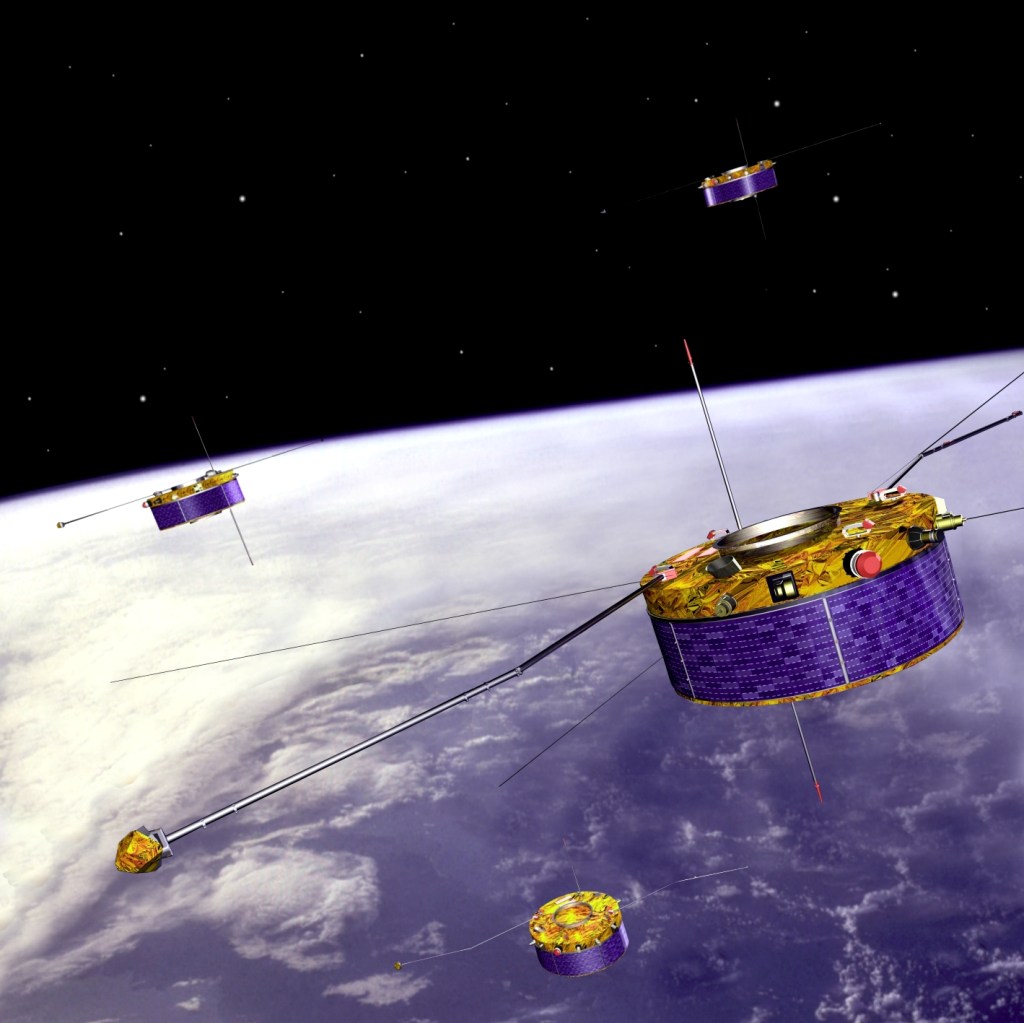
01—Cluster’s Final Experiment Was Its Own Destruction
ESA’s Cluster mission spent more than two decades studying Earth’s magnetic environment.
Then the four satellites became the experiment.
Salsa reentered in 2024.
Rumba followed in 2025.
Samba and Tango came down on August 31 and September 1, 2026.
All four were deliberately placed on targeted reentry paths over remote parts of the South Pacific.
Because the spacecraft were nearly identical, ESA gained something engineers rarely get: repeated observations of the same basic satellite design breaking apart under different trajectories and atmospheric conditions.
The mission ended by becoming a controlled reentry laboratory.
02—Why Engineers Still Do Not Fully Understand Satellite Breakup
A satellite entering the atmosphere experiences extreme heating, aerodynamic forces and rapidly changing pressure.
Components melt.
Structures bend.
Panels tear away.
Tanks rupture.
Materials vaporise.
Fragments separate and heat at different rates.
Engineers can model that sequence, but real reentries are difficult to observe. Most happen with large uncertainties in time and location. By the time a team knows exactly where to look, the spacecraft may already be gone.
Cluster gave ESA a way to change that.
03—Targeted Reentry Makes a Normally Unpredictable Event Observable
A targeted reentry is not the same as actively steering a spacecraft through every second of atmospheric descent.
Instead, operators adjust the orbit months or years earlier so the natural final reentry occurs over a chosen remote region.
As the orbit decays, tracking data improves the predicted time and location.
The advantage is safety and observability.
ESA could place Cluster’s final trajectories over sparsely populated parts of the South Pacific and then position aircraft and instruments where scientists expected the breakup to occur.
That turns an uncertain event into something close enough to schedule.
04—Salsa Was the First Test in 2024
Salsa became the first Cluster spacecraft to perform the new targeted reentry approach.
It entered the atmosphere on September 8, 2024 over the South Pacific.
ESA had adjusted its orbit earlier that year to move the final reentry toward a remote region.
Scientists then attempted an airborne observation campaign.
The event was important for two reasons.
It demonstrated that a highly eccentric spacecraft could be placed on a safer final trajectory.
And it showed that the reentry could be predicted well enough for researchers to observe it from an aircraft.
05—Rumba Repeated the Method in 2025
Rumba reentered on October 22, 2025 at 20:59 CEST.
Like Salsa, it had been placed on a targeted trajectory over a remote part of the South Pacific.
The second reentry helped ESA confirm that the method was repeatable.
That matters more than one successful demonstration.
A technique becomes operationally useful only when teams can reproduce it across multiple spacecraft and changing atmospheric conditions.
Rumba turned the first Cluster experiment into the beginning of a series.
06—Samba and Tango Were the Final Pair
The final two Cluster spacecraft were Samba and Tango.
ESA adjusted their trajectories so they would reenter about one day apart in late August and early September 2026.
Samba reentered on August 31 at 21:39:38 UTC.
Tango followed on September 1 at 21:30:31 UTC.
Both came down over remote South Pacific regions.
That close timing created an unusual experiment.
Scientists could use nearly the same observation setup for two almost identical spacecraft under slightly different conditions.
07—ESA Moved the Satellites to Meet an Airplane
The phrase sounds backwards.
Usually an aircraft flies to meet a satellite’s predicted reentry path.
ESA did both.
Mission controllers adjusted Samba and Tango in advance so their eventual reentries would occur where an airborne observation campaign could reach them.
The ROSIE team then launched from Tonga with a plane full of cameras and scientific instruments.
This required orbital mechanics, reentry prediction, ground-based tracking and flight planning to line up within a narrow window.
The satellite was moving at orbital speed.
The aircraft was trying to be in the right piece of sky at exactly the right moment.
08—29 of 30 Instruments Captured Both Reentries
ESA says the ROSIE team successfully observed both Samba and Tango with 29 of the 30 instruments aboard the aircraft.
That is an unusually rich dataset for atmospheric reentry.
Different instruments can measure different aspects of the breakup.
Tracking cameras show the overall fragmentation.
Spectral instruments can help identify glowing materials.
Other sensors can constrain timing, brightness and physical evolution.
The value is not one dramatic video.
The value is synchronised measurements of the same event from multiple instruments.
09—The Plane Saw Dozens of Fragments
Samba’s reentry produced more visible fragmentation detail than ESA’s earlier observation campaign.
ESA reported more than 50 seconds of footage from one tracking camera.
Instead of only a few bright fragments, the team could see dozens of pieces streaking across the sky.
That gives engineers a better timeline of when the spacecraft began to break apart and how fragmentation progressed.
If spectral data can be correlated with those fragments, researchers may also be able to infer which spacecraft components were failing at different moments.
10—Tango’s Prediction Was Precise Enough for the Pilot to Help the Science
Tango’s final reentry was predicted with enough accuracy that the observation aircraft could position itself for the event.
ESA says the pilot even banked the aircraft at the right moment to keep the burning spacecraft in the instruments’ field of view for a few extra seconds.
That detail shows how far reentry prediction improved during the Cluster campaign.
A few extra seconds matter when the entire high-value breakup sequence may last less than a minute.
11—Four Identical Satellites Make the Dataset Unusually Clean
Comparing different spacecraft is difficult.
One satellite has large solar arrays.
Another has a different tank design.
Another uses different structural materials.
Another has a completely different mass distribution.
Cluster removes much of that variation.
Rumba, Salsa, Samba and Tango were built as four nearly identical spacecraft for formation flying.
That gives researchers repeated examples of similar structures encountering reentry at different times, angles, speeds and atmospheric conditions.
The spacecraft become controlled variables.
The environment becomes the changing variable.
12—This Is Why the Experiment Matters for Reentry Models
A reentry simulation tries to predict when a spacecraft begins to fail.
Which components detach first?
How quickly do they heat?
Which materials melt?
Which structures survive longer?
What fragments might remain intact?
Real observations allow engineers to compare those predictions with what actually happened.
If a model predicts breakup too early, too late or in the wrong order, engineers can adjust the assumptions.
Better models improve both mission planning and risk calculations.
13—The Goal Is Design for Demise
Modern spacecraft can be designed so that more of the vehicle burns up completely during reentry.
This idea is often called design for demise.
The engineering challenge is that a satellite still has to survive launch and years in space.
A structure cannot simply be made weak.
It has to remain strong enough for its mission while becoming easier to destroy under atmospheric reentry conditions.
Real breakup data helps engineers find that balance.
14—Fuel Tanks Are a Good Example of the Problem
Some spacecraft components are much harder to destroy than thin panels.
Pressure vessels and tanks can be built from strong, heat-resistant materials.
That is good during launch and operation.
It can be undesirable during reentry if the same component survives long enough to reach the ground.
Design-for-demise research asks whether geometry, materials or construction methods can preserve mission reliability while increasing the probability that those components break apart and melt earlier.
15—Ground Risk Is Only One Part of the Question
The traditional concern is simple.
Will surviving debris hit people or infrastructure?
That remains important.
But ESA is also interested in what reentry introduces into the atmosphere.
Satellites contain metals, composites, electronics and coatings.
As those materials vaporise, they enter atmospheric chemistry in forms that are still being studied.
A future with many more satellites means many more reentries.
Understanding material deposition is becoming part of sustainable spaceflight.
16—More Satellites Mean Reentry Science Matters More Every Year
Low Earth orbit is becoming more crowded.
Large satellite constellations increase launch rates.
They also increase disposal rates.
A spacecraft designed for a five-year life may eventually be replaced and reentered.
Repeat that across thousands of satellites and atmospheric reentry becomes a routine industrial process rather than a rare event.
That makes uncertainties that were once acceptable more important.
Small errors in breakup models can scale into large uncertainties across many spacecraft.
17—Cluster Was Built Before Today’s Debris Rules
The four Cluster spacecraft were launched in 2000.
They were designed in the 1990s.
Modern debris-mitigation standards were not the same then as they are today.
ESA could have allowed the spacecraft to reenter naturally after their missions.
Instead, operators used the remaining control capability to reduce uncertainty and target remote ocean regions.
That turned an old mission into a test of newer sustainability principles.
18—The Mission Also Demonstrated End-of-Life Control
Space sustainability is not only about what happens during atmospheric breakup.
It also depends on what operators do before reentry.
A spacecraft nearing the end of its life may still have propulsion, attitude control and tracking capability.
Using that remaining capability to shape the final orbit can reduce risk.
Cluster shows how an old spacecraft can be actively managed long before the final atmospheric encounter.
The reentry is the final step of an end-of-life strategy that begins much earlier.
19—Why This Is Not the Same as a Fully Controlled Reentry
The term targeted reentry can sound like the spacecraft is piloted all the way down.
It is not.
Cluster’s satellites were positioned in advance.
Atmospheric drag and orbital decay then determined the exact final timing.
The prediction improved as the event approached, but uncertainty remained.
A fully controlled reentry typically uses propulsion much later to target a disposal corridor more directly.
Cluster’s technique sits between uncontrolled decay and fully controlled descent.
That middle ground is valuable for spacecraft that do not have enough fuel or propulsion authority for a conventional controlled deorbit.
20—The Precision Improved Across the Campaign
ESA says lessons from earlier Cluster reentries helped improve later prediction and observation.
For Samba, the final predicted reentry time was accurate to the second.
That kind of accuracy is extraordinary compared with the large uncertainty windows often associated with uncontrolled satellite reentries.
Better tracking and better atmospheric models can narrow the window.
Repeated data can then improve the models again.
The experiment becomes a feedback loop.
21—The Next Mission Will Watch Reentry From the Inside
Cluster could only be observed from outside.
ESA’s next step is Draco.
Draco is scheduled for launch in 2027 with one main purpose: destroy itself while recording what happens internally.
The spacecraft will carry more than 200 sensors and four cameras.
Those instruments will measure temperature, pressure, structural strain and visual breakup.
Cluster gives the external view.
Draco is designed to give the internal view.
22—Draco Is Basically a Flying Crash-Test Dummy
The analogy is useful.
Car crash tests use instrumented vehicles because engineers need to know what happens inside the structure during impact.
Draco applies a similar philosophy to atmospheric reentry.
The spacecraft is expected to survive only hours in orbit before being sent back into the atmosphere.
Its mission is not Earth observation.
Not communications.
Not astronomy.
Its destruction is the experiment.
The spacecraft exists to produce failure data.
23—More Than 200 Sensors Will Record the Breakup
ESA says Draco will carry more than 200 sensors.
The sensors are intended to measure quantities such as temperature, pressure and structural strain.
Four cameras will add visual context.
That should allow engineers to correlate what happens inside the spacecraft with what external observers see.
A structural component might experience rising strain.
Then a camera records movement.
Then external observers see a fragment separate.
That combined timeline is far more valuable than any one measurement alone.
24—The Data Has to Survive the Event That Destroys the Satellite
Draco has an obvious problem.
The spacecraft recording the data is also the spacecraft being destroyed.
ESA therefore plans an extremely robust capsule that can protect the recorded data through the destructive sequence.
The capsule becomes a reentry black box.
The rest of the spacecraft can burn and fragment.
The experiment succeeds only if the data survives long enough to be recovered.
25—Cluster and Draco Form One Continuous Experiment
Cluster gives researchers multiple external observations of four similar spacecraft.
Draco adds an internal instrumented view.
Together, the datasets can connect visible fragmentation with actual physical conditions inside the vehicle.
That can improve reentry models more directly than either dataset alone.
The external image tells engineers when something happened.
The internal sensors may help explain why.
26—Better Models Could Change How Future Satellites Are Built
If engineers know which components consistently survive too long, those components can be redesigned.
If models reveal that a certain joint breaks later than expected, the structure can change.
If one material vaporises differently from predictions, thermal models can be updated.
Reentry science can therefore influence design decisions years before a spacecraft ever flies.
The final minutes of one mission become input to the first drawings of another.
27—What ESA Has Actually Confirmed
ESA has completed four targeted reentries of the Cluster spacecraft.
Salsa reentered on September 8, 2024.
Rumba reentered on October 22, 2025.
Samba reentered on August 31, 2026.
Tango reentered on September 1, 2026.
Samba and Tango were successfully observed from a ROSIE aircraft mission operating from Tonga.
ESA says 29 of the 30 instruments aboard captured both reentries.
The agency says the resulting dataset will improve reentry models, safer satellite design and understanding of atmospheric effects.
ESA’s Draco mission is scheduled for 2027 with more than 200 sensors, four cameras and a protected data capsule.
28—What We Should Not Claim
We should not say ESA actively piloted Cluster through the atmosphere.
The satellites were placed on targeted trajectories in advance.
We should not say every fragment burned up completely.
The purpose of the research is partly to understand which components can survive.
We should not say Cluster proves all satellites can use the same disposal method.
Spacecraft geometry, propulsion and orbit matter.
We should not say Draco has already flown.
It is scheduled for 2027.
And we should not say reentry pollution is fully understood.
ESA explicitly says more data is needed.
29—A Satellite’s Death Is Becoming Part of Its Engineering
For most of the space age, the exciting engineering happened before launch.
Build the spacecraft.
Survive the rocket.
Complete the mission.
Disposal came last.
That is changing.
When thousands of satellites eventually return through the atmosphere, the final minutes become part of responsible spacecraft design.
Cluster’s last contribution was not another magnetosphere measurement.
It was four controlled chances to watch a spacecraft die.
If those observations help future satellites burn up more completely, fall more predictably and leave less behind, then the end of Cluster may influence spacecraft that have not even been designed yet.