
01—Building your own AI rarely means training from zero
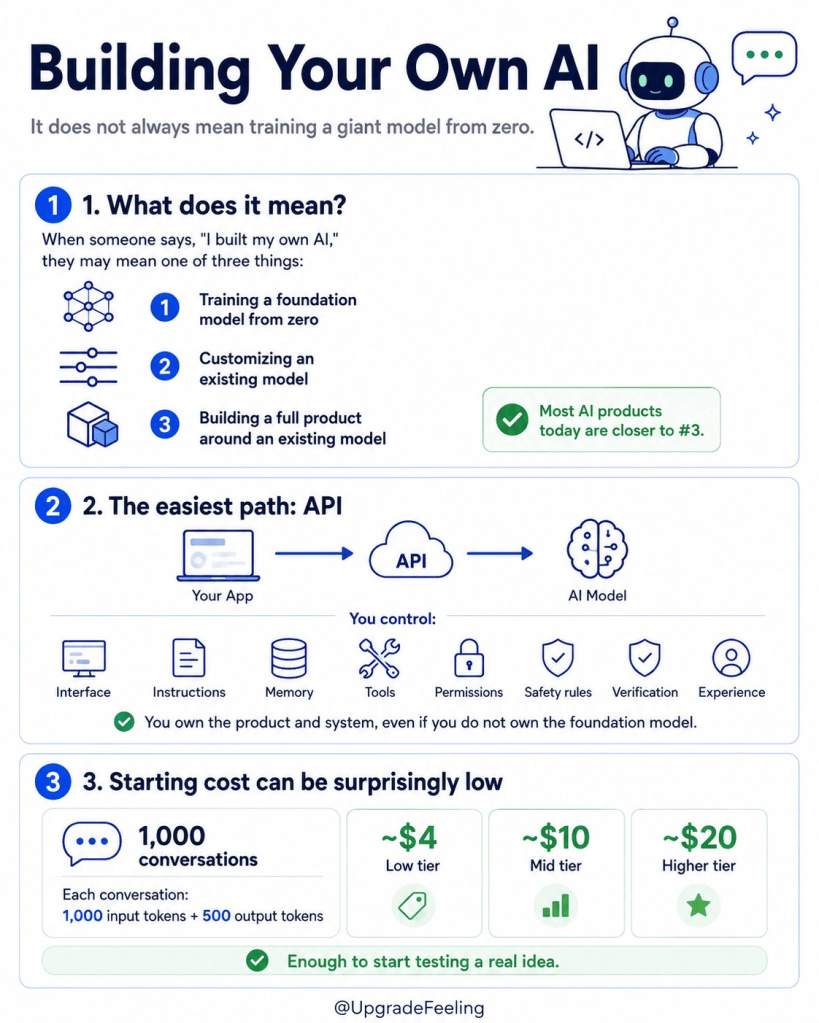
When someone says, “I built my own AI,” that phrase can describe several very different things.
At one extreme, it can mean training a foundation model from scratch. That is the expensive research-lab version: huge datasets, large accelerator clusters, long training runs, evaluation infrastructure, and a team capable of operating the whole stack.
But most useful AI products are much closer to another definition: an existing model sits inside a system you designed.
You decide what the product knows, how it answers, which tools it can use, what it is allowed to change, when it should refuse, how memory works, and how its output is checked before anything important happens.
That is still real AI engineering. In many cases, it is the part that determines whether the product is actually useful.
The practical question is therefore not “How do I train my own giant model?” It is “What is the smallest AI system that can solve the problem I care about?”
02—The easiest starting point is usually an API
For a new idea, the fastest route is often an API.
Your application owns the interface, instructions, product logic, memory layer, tools, permissions, safety rules, verification, and user experience. The model provides the underlying language or reasoning capability.
That distinction is useful because it separates the product from the foundation model.
You may not own the base model, but you still own the system around it. A support assistant, document analyst, internal research tool, workflow agent, or domain-specific copilot can all be meaningful products without training a model from zero.
This is also where experimentation becomes cheap enough for one person or a small team. Instead of buying hardware first, you can test whether the idea deserves more engineering.
The original thread used simple token-cost examples to make that point: early experiments can be inexpensive compared with training. Exact API prices move over time, so the numbers should be treated as pricing snapshots rather than permanent constants.
03—RAG gives the model a private library instead of retraining it
If the problem is knowledge, retraining may be the wrong first move.
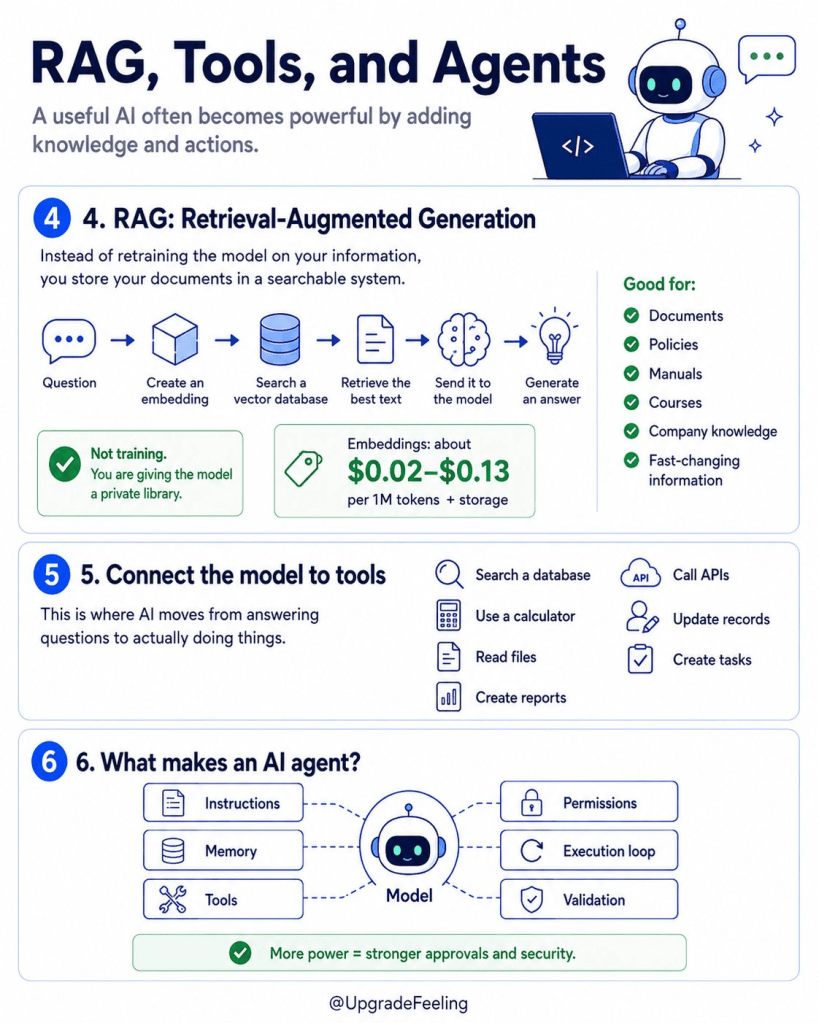
Retrieval-Augmented Generation, or RAG, keeps your documents in a searchable system. A user asks a question, the system creates an embedding for the query, searches a vector database, retrieves the most relevant text, and passes that context to the model before it generates an answer.
The model has not permanently learned those documents. It is being given the right material at request time.
That makes RAG a natural fit for manuals, policies, courses, company knowledge, internal documentation, and information that changes frequently.
It also separates two jobs cleanly: the retrieval system decides what information is relevant, while the model turns that information into a useful response.
The thread’s visual used embedding costs of roughly $0.02 to $0.13 per million tokens as an example. Those figures align with current OpenAI pricing for its small and large text-embedding models, before storage and the rest of the retrieval stack are added.
For many practical products, that is a much more sensible first step than teaching the model the same documents through training.
04—Tools are where the model starts doing things
A model can answer a question on its own. A system becomes more capable when it can call tools.
Those tools might search a database, call an API, use a calculator, read a file, update a record, create a task, or generate a report.
This is the transition from “chatbot” to something closer to an operational assistant.
An agent adds structure around that tool use. At minimum, the system needs instructions, memory or context, a set of tools, permissions, an execution loop, and some form of validation.
Permissions matter because capability and authority are different things.
A model may be capable of drafting a database update, but the product still has to decide whether it can execute that update automatically, ask for approval, or refuse. The stronger the action, the stronger the approval and validation layer should become.
That is why a useful agent is not just a model plus a long prompt. The surrounding system is what turns model output into controlled behavior.
05—Fine-tuning changes behavior; LoRA changes less of the model
Fine-tuning becomes interesting when the problem is not simply missing knowledge.
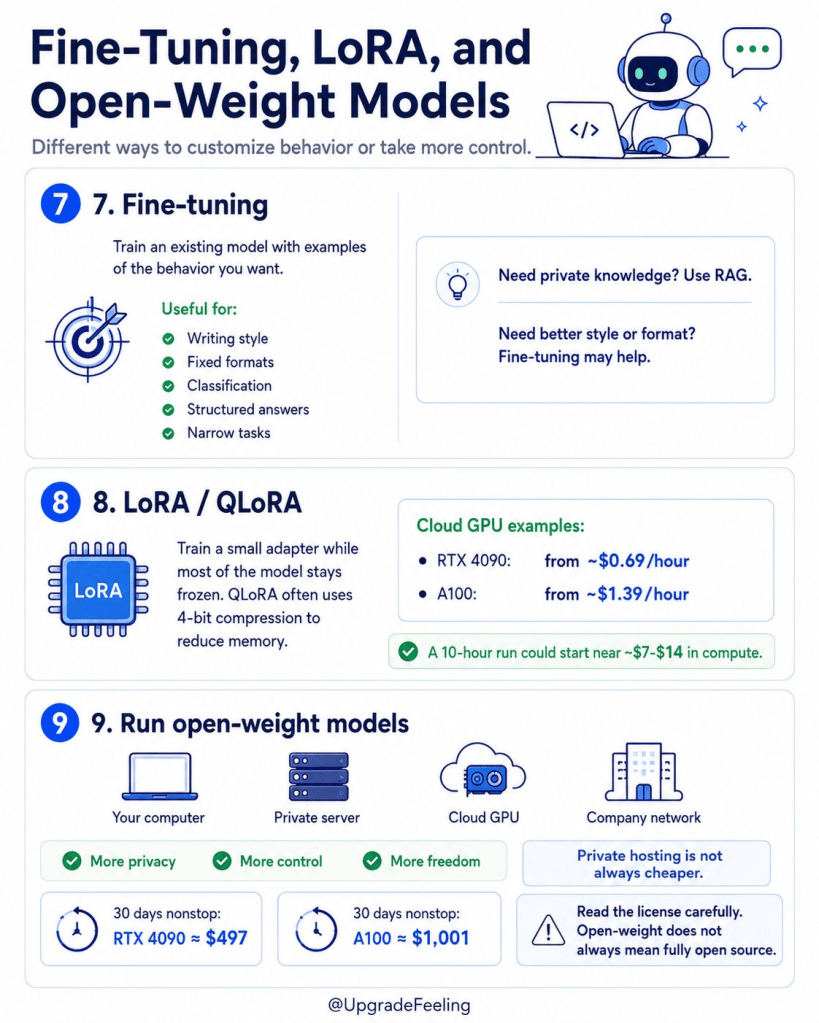
If you want a model to follow a consistent format, classify a narrow set of inputs, produce structured answers, or adopt a particular response pattern, examples can be used to adapt an existing model.
That is a different job from RAG.
RAG supplies information at runtime. Fine-tuning changes model behavior.
Parameter-efficient methods such as LoRA reduce how much of the model needs to be trained. Instead of updating every parameter, LoRA freezes the original weights and learns much smaller low-rank update matrices. That lowers the number of trainable parameters and can reduce memory and training requirements.
QLoRA goes further by combining LoRA-style adaptation with quantization. Hugging Face’s current PEFT documentation describes the common QLoRA approach as quantizing the base model to 4 bits before training the adapter.
These techniques make customization much more accessible than full-model fine-tuning, especially when the task is narrow and the base model is already strong.
06—Open-weight models give you another level of control
Sometimes the reason to move beyond an API is control.
An open-weight model can run on your own computer, a private server, a cloud GPU, or infrastructure inside a company network. That can give you more control over deployment, latency, data flow, model versions, and how the system is integrated.
It does not automatically mean cheaper.
A GPU running continuously has a real cost, and private hosting adds operations, storage, monitoring, updates, and engineering work. The thread’s GPU prices were explicitly a July 30, 2026 snapshot, not permanent market prices.
It is also worth separating “open-weight” from “fully open source.” Downloadable weights do not automatically tell you what training data was used, which rights the license grants, or whether every part of the training stack is available.
The practical value is choice. You can stay with an API when that is enough, then move toward self-hosting when privacy, control, latency, or integration makes the extra work worthwhile.
07—Distillation and continued pretraining sit further up the complexity ladder
Once a team already has a working system, there are deeper ways to specialize it.
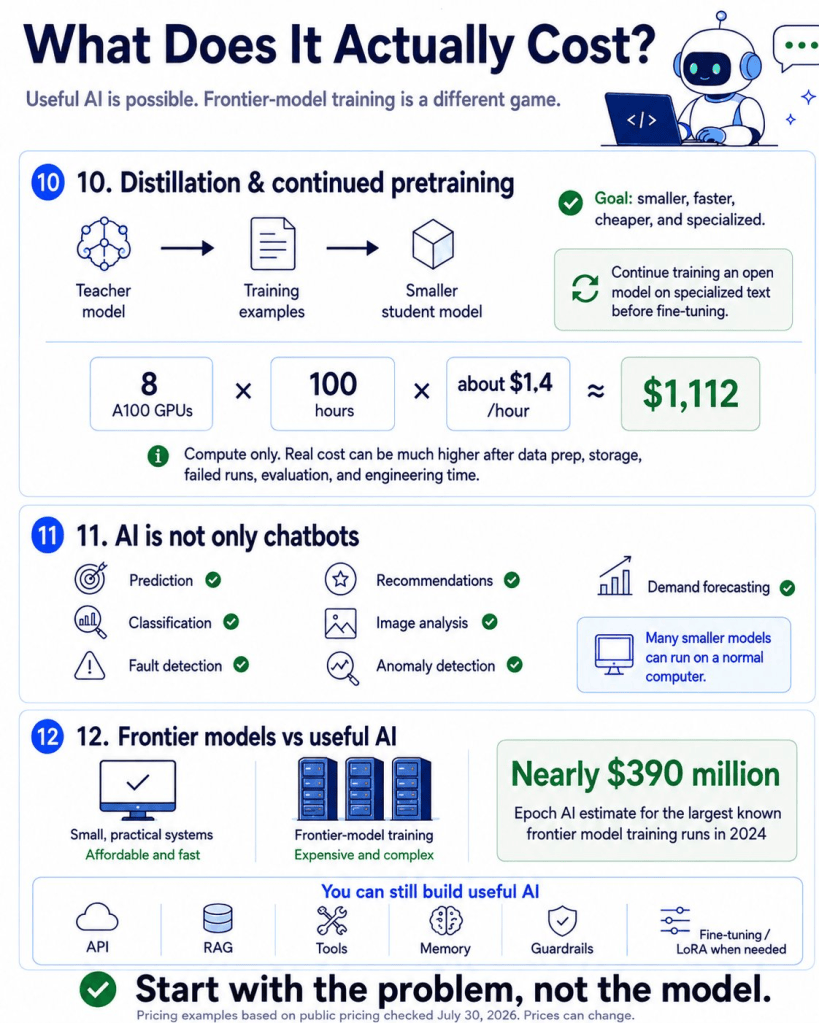
Distillation can use a stronger teacher model to generate training examples for a smaller student model. The goal is often a model that is cheaper, faster, or more specialized for a narrow workload.
Continued pretraining is different. Instead of starting with supervised behavior examples, you continue training an existing model on domain-specific text before later fine-tuning it.
Both approaches can be useful, but they move the project into a more serious training workflow: datasets, accelerator time, checkpoints, evaluation, failed runs, storage, and engineering effort all start to matter more.
The original thread illustrated this with an eight-A100, 100-hour example. At the thread’s July 30 pricing snapshot of $1.39 per GPU-hour, that arithmetic is $1,112 for compute alone.
That figure should not be read as a current market quote. Its purpose is to show the structure of the cost: compute is only one line item, and real training work can cost substantially more once preparation and iteration are included.
08—Frontier training is a different economic category
The final distinction is scale.
A small AI product built with APIs, RAG, tools, an open-weight model, or a parameter-efficient adapter belongs to a very different economic category from a frontier-model training run.
Epoch AI has estimated the final training compute for GPT-4.5 at about $386 million, with a wide uncertainty range. Its broader research has also documented how frontier-model training costs have risen rapidly over time.
That does not mean “building AI” is out of reach.
It means the phrase covers multiple layers of the stack.
One person can build a useful AI system without owning a frontier model. A small team can add retrieval, tools, memory, guardrails, and specialized behavior. A larger team can move into self-hosting, LoRA, distillation, or continued pretraining when the product actually requires it.
The mistake is treating all of those choices as if they were the same project.
09—The Upgrade Feeling
Start with the problem, not the model.
Use the cheapest and simplest method that can solve it. Add RAG when the system needs private or changing knowledge. Add tools when it needs to act. Add permissions and validation before those actions become important. Fine-tune when behavior needs to change. Move to open weights or deeper training only when the control is worth the added complexity.
That progression is what makes AI development much more accessible than the phrase “build your own model” suggests.
The opportunity is no longer limited to organizations that can train frontier systems.
The difficult part is choosing the right layer of complexity—and refusing to add the next one until the product actually needs it.