
01—Frigade learns the product before it tries to explain it
Frigade launched its Assist API on September 8, 2026 with a different approach to product-aware AI.
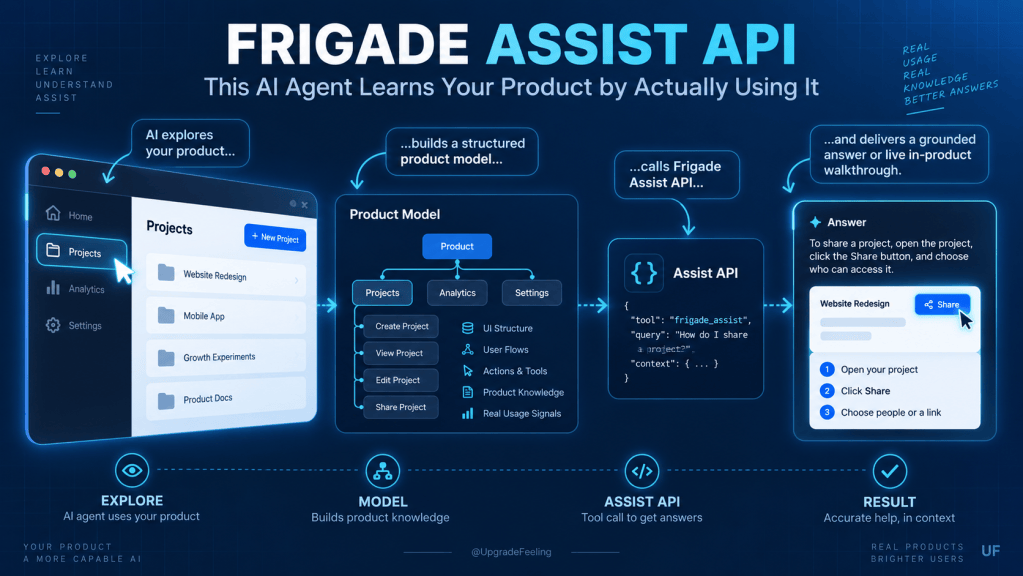
Instead of starting with a static description of an application, Frigade sends a browser agent through the product itself.
The agent signs in with user-level permissions, works through real workflows and maps how the product is organized. It sees where settings live, how multi-step flows connect and which actions appear in the interface.
That creates a working product model built from behavior rather than from a list of feature descriptions.
For an AI agent, that is a meaningful change in context. The system is not only told what the product can do. It is given a representation of how the product is actually used.
02—The product model is rebuilt as the software changes
The second part of the architecture is continuous relearning.
Frigade says its browser agent trains again when a new release ships. New workflows can be mapped, moved controls can be rediscovered and the product model can be updated around the current version.
That makes the model a living layer between the software and the agent using it.
Instead of treating product knowledge as a one-time ingestion job, Frigade treats it as something that evolves with the application.
The idea is simple: the agent should understand the version of the product the user is looking at now.
That is especially useful for fast-moving SaaS products where navigation, permissions and workflows can change frequently across releases.
03—Assist API turns that product model into one tool call
The new Assist API exposes that product knowledge to an agent a company has already built.
Frigade is registered as a tool inside the existing agent. When the agent needs product-specific help, it can call Frigade with the user’s intent and identity.
Frigade then returns either a grounded answer or guidance for the workflow inside the product.
The host agent keeps its own model, reasoning, voice and conversation.
That architectural choice matters because Frigade does not need to become a second assistant competing for the same user interaction. It acts as a specialized capability inside the agent that already owns the conversation.
In practical terms, the agent remains the orchestrator. Frigade becomes its product-expertise layer.
04—A question can become a walkthrough inside the interface
The response does not have to stop at text.
Frigade can turn the product model into an in-product walkthrough that highlights the actual controls involved in a task.
If a user asks how to configure a feature, the agent can call Frigade and guide the user through the live interface step by step.
Frigade’s product page shows this as a workflow where the user stays on the page they are already using while guidance appears around the relevant controls.
That creates a tighter loop between explanation and action.
The same system that understands the workflow can render that workflow back into the interface as guidance.
05—The host agent still decides when Frigade should be used
Frigade is designed as a capability rather than a replacement for the main agent.
The existing agent decides when a product question needs Frigade and what to do with the result.
Frigade says the Assist API is framework-agnostic and works with the Vercel AI SDK today. If an agent can call a tool, it can call Frigade.
That makes the integration model familiar to developers already building agentic systems.
The language model handles reasoning and conversation. The tool layer handles specialized capabilities. Frigade contributes product knowledge and interface guidance.
The separation keeps the architecture modular. Teams can keep the agent stack they already built while adding a component that understands the application from the inside.
06—Permissions follow the user through the workflow
Product guidance also needs to understand what a specific user is allowed to see.
Frigade says its browser agent works with real user permissions, and guidance runs with the user’s own access level.
That means the product model is not only about where buttons and pages exist.
Permissions become part of the execution context.
An administrator may see one route through a workflow while another user role may see a different set of controls. Frigade can work inside that context instead of assuming every user sees the same application.
This is an important detail for business software, where product behavior is often shaped by roles, plans, workspace settings and organization-level permissions.
07—The same engine gives product teams a feedback surface
The Assist API also feeds the conversations back into Frigade’s management layer.
Frigade says every interaction handled through the API can appear in its dashboard, where support and customer-experience teams can review responses, rate them and steer future behavior without changing application code.
That creates another loop around the agent.
The browser agent learns the product. The existing AI agent calls that knowledge when needed. Users interact with the result. Product and support teams can then inspect how those interactions performed and refine the behavior.
The wider platform connects product learning, live guidance, agent orchestration and human steering around the same workflow.
08—The Upgrade Feeling
Frigade Assist API is interesting because it changes where an AI agent gets product expertise.
The agent still has a language model. It can still use documentation, tools and connected data.
But now it can also call a system that has actually moved through the product, mapped the workflows and relearned them after the software changed.
That creates a more operational form of context.
The application itself becomes part of the knowledge source.
A browser agent learns it. A product model preserves what was learned. The existing agent calls that model as a tool. The answer can then return as either text or a live walkthrough inside the interface.
That is the upgrade: product knowledge is becoming something an AI system can continuously experience, model and use.