
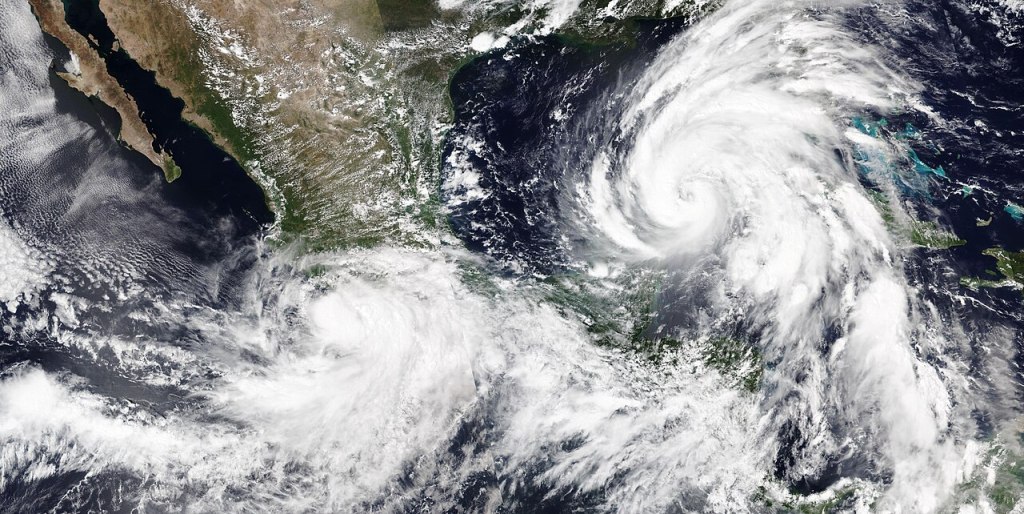
01—The Most Useful Weather Forecast Is Often Not One Number
A weather app usually gives you a simple answer.
28°C.
40% chance of rain.
Wind at 18 km/h.
A storm track drawn as one line.
Real weather is not that clean.
The atmosphere can evolve along several plausible paths.
A small change in pressure, moisture or steering winds can shift a storm.
Cloud cover can change solar generation.
Wind uncertainty can change grid planning.
A single best forecast hides that uncertainty.
Aurora 1.5 is interesting because Microsoft is pushing its AI weather model toward a more honest output:
not only what it thinks will happen,
but how wide the range of possible outcomes might be.
02—Aurora 1.5 Is an Upgrade to Microsoft’s Earth-System Foundation Model
Aurora began as a 1.3-billion-parameter foundation model trained across a large collection of atmospheric and Earth-system data.
The original project showed that one pretrained model could be adapted to different forecasting tasks, including weather, air pollution and ocean waves.
Aurora 1.5 builds on that foundation.
Microsoft says the new version was developed by Microsoft Weather as an extension of the original Aurora work from Microsoft Research AI for Science.
The update focuses less on proving that AI can forecast weather at all.
That question is already past the demo stage.
The new focus is making the forecasts more useful for real operational decisions.
03—The Headline Upgrade Is Probabilistic Ensemble Forecasting
A deterministic forecast produces one future.
An ensemble forecast produces many.
Each member begins from slightly different conditions or introduces controlled variation into the model.
If the forecasts remain close together, uncertainty is relatively low.
If they spread apart, the atmosphere is telling you the outcome is less predictable.
That spread is useful.
A power-grid operator may care about the risk of low wind generation.
An airline may care about the range of possible storm positions.
An emergency planner may care about the probability of severe rainfall.
The distribution can matter more than the single most likely answer.
04—This Is How Traditional Weather Centers Already Think
Probabilistic forecasting is not an AI invention.
Major weather centers have used ensemble systems for years.
The ECMWF Ensemble Prediction System runs multiple forecasts to represent uncertainty.
Forecasters compare ensemble members, cluster outcomes and look at the probability of high-impact events.
Aurora 1.5 is important because AI forecasting is moving into that same operational language.
The comparison is no longer only:
Can AI generate one forecast faster?
It becomes:
Can AI represent uncertainty well enough to compete with a mature numerical ensemble system?
05—Microsoft Says Aurora 1.5 Beats ECMWF ENS on 88.9% of Evaluated Targets
Microsoft reports that Aurora 1.5’s ensemble forecasts outperform the ECMWF operational ensemble on 88.9% of the evaluated variable-and-lead-time targets across days 1 through 10.
The evaluation includes upper-air geopotential, temperature and humidity along with several surface variables.
That sounds dramatic.
The wording needs discipline.
It does not mean Aurora is 88.9% more accurate.
It does not mean it wins every forecast.
It means that across the specific evaluated combinations of variables and lead times, its probabilistic error metric was better in 88.9% of them.
That is still a strong result.
It is also a narrower claim than a headline can make it sound.
06—Aurora 1.5 Adds 22 More Forecast Variables
The original Aurora weather setup exposed a relatively small set of core surface variables.
Aurora 1.5 greatly expands that.
Microsoft says the update adds 22 more variables covering categories such as wind, temperature, humidity, precipitation, cloud cover and radiation.
The project FAQ describes 21 new output variables plus one additional input variable.
That expansion matters because real decisions are not made from temperature alone.
Solar farms need cloud and radiation information.
Aviation needs wind.
Agriculture needs precipitation and humidity.
Energy systems need multiple variables working together.
07—Hourly Resolution Is a Bigger Upgrade Than It Sounds
Aurora’s earlier weather models were commonly used on six-hour forecast steps.
Aurora 1.5 adds variable lead-time support down to one hour.
That makes the forecast much more useful for rapidly evolving conditions.
A thunderstorm can develop inside six hours.
Cloud cover can change solar output within an hour.
Wind ramps can affect power systems quickly.
Rainfall timing matters for transport and flood response.
Hourly output moves the model closer to the time scale where operational decisions are actually made.
08—The Model Does Not Simply Run the Same Forecast 50 Times
A useful ensemble needs meaningful diversity.
Microsoft says Aurora 1.5 introduces stochastic perturbations into the model’s latent conditioning pathway.
In simpler terms, controlled randomness is injected inside the neural network so different runs can explore different plausible atmospheric futures.
The model is then optimized using a probabilistic objective rather than only a deterministic one.
That encourages the ensemble to represent uncertainty, not merely generate noisy copies of the same forecast.
09—CRPS Changes What the Model Is Rewarded For
The technical paper says Aurora 1.5 uses the Continuous Ranked Probability Score, or CRPS, during ensemble fine-tuning.
CRPS evaluates the quality of a probability distribution.
A good probabilistic forecast should place high probability near what actually happens.
It should also avoid being overconfident.
That matters because an ensemble can look impressive while being badly calibrated.
Ten similar wrong forecasts are not useful uncertainty.
The model has to learn both accuracy and spread.
10—Calibration Is the Quiet Part of Weather AI
A forecast can have low average error and still be dangerous if it is overconfident.
Suppose a model predicts a storm track tightly clustered around one path.
If the real storm repeatedly falls outside that spread, the ensemble is under-dispersed.
It looks more certain than it should.
The Aurora 1.5 paper says reliability diagnostics show slight over-dispersion rather than the under-dispersion often seen in dynamical models.
That means Aurora’s spread may sometimes be a little wider than necessary.
In risk-sensitive forecasting, mild over-dispersion can be preferable to false certainty.
But calibration remains something that needs continuous evaluation.
11—The Hurricane Result Is More Useful Than a Generic Benchmark
Tropical cyclones are where probabilistic forecasting becomes easy to understand.
A hurricane track is not one line.
It is a family of possible paths.
Aurora 1.5 was evaluated across tropical cyclones from 2024 and 2025.
The technical paper reports a 16% reduction in tropical-cyclone track error compared with the original Aurora.
Microsoft’s blog also shows that the ensemble median can achieve larger reductions at some lead times, reaching roughly one-third lower track error by day five.
Those are related but different statistics.
They should not be collapsed into one number.
12—Hurricane Helene Shows What an Ensemble Adds
Microsoft uses Hurricane Helene as a visual example.
Instead of drawing one predicted track, Aurora 1.5 produces multiple plausible paths.
The observed storm track sits within that spread.
That is exactly how uncertainty should be communicated.
The model is not pretending to know one exact future days in advance.
It is defining a probability region that can narrow or shift as new observations arrive.
For emergency planning, that is far more useful than a single smooth line that invites false precision.
13—A Better Track Forecast Is Not a Complete Hurricane Forecast
Track error measures where the storm goes.
It does not automatically measure everything people care about.
Intensity matters.
Rainfall matters.
Storm surge matters.
Wind-field size matters.
Rapid intensification matters.
A model can improve track prediction and still miss other hazards.
Microsoft’s results should therefore be read for what they are.
Aurora 1.5 shows strong reported performance on storm tracks.
That does not mean the hurricane forecasting problem is solved.
14—Aurora 1.5 Also Reports a Large Heatwave Improvement
The technical paper reports another striking number.
Compared with the original Aurora, Aurora 1.5 reduced mean absolute error on top-5th-percentile heatwaves by 58%.
That suggests the fine-tuning improved behavior in rare high-temperature conditions.
Again, this is a reported evaluation result from the Aurora 1.5 research.
It does not mean every local heatwave will be predicted 58% better.
Extreme-event metrics depend on dataset, threshold, region and evaluation design.
The result is promising because extremes are exactly where average-weather accuracy can be misleading.
15—Extreme Weather Is Where Probabilities Matter Most
For normal conditions, a slightly wrong forecast can be annoying.
For extreme conditions, uncertainty changes decisions.
Will a tropical cyclone curve toward the coast?
Could temperature exceed a grid-stress threshold?
Could rainfall move into a flood-risk range?
Could wind generation collapse during peak demand?
The user does not need only the most likely value.
They need the probability of crossing a dangerous threshold.
That is why ensemble forecasting is a more important operational step than another small improvement in average forecast error.
16—Cloud Cover and Radiation Connect Weather AI Directly to Energy
Aurora 1.5 adds variables including cloud cover and radiation fields.
Those are not cosmetic additions.
Solar-power output depends directly on incoming radiation.
A grid balancing large amounts of renewable power needs to know not only tomorrow’s average weather but the timing and uncertainty of cloud movement.
Probabilistic cloud and radiation forecasts can help estimate a range of possible power output.
That connects atmospheric forecasting to energy-system planning in a much more direct way.
17—Hourly Forecasts Matter for Renewable Ramps
Renewable energy can change quickly.
A cloud front can reduce solar generation.
A wind shift can raise or lower wind output.
Grid operators have to balance supply and demand continuously.
A six-hour forecast interval can miss the timing of those ramps.
Hourly Aurora output provides a finer view.
The ensemble adds another layer by showing how uncertain that ramp timing is.
That combination — finer time resolution plus uncertainty — is exactly what operational energy forecasting needs.
18—The Foundation-Model Idea Is Still the Bigger Architecture
Aurora is not built as one narrow hurricane model.
It is a foundation model.
The system is pretrained on broad atmospheric information and then fine-tuned for specialized tasks.
That architecture has already been applied to medium-range weather, high-resolution weather, air pollution and ocean waves.
Aurora 1.5 shows how the same base model can be extended again without starting from zero.
That is the research bet:
one general Earth-system representation,
many forecasting heads and fine-tuned behaviors.
19—Microsoft Is Keeping the Research Model Open
Microsoft says Aurora is available as an open research model.
The implementation is published on GitHub and model checkpoints are distributed through Hugging Face.
The FAQ says Aurora is available under an MIT license.
Aurora 1.5 documentation is also available in the public repository.
That matters because weather agencies and researchers need to inspect, test and compare these models independently.
Operational trust cannot come from a benchmark chart alone.
20—The Same Model Is Also Moving Into Microsoft’s Commercial Infrastructure
Open research is one side of the strategy.
Managed access is the other.
Microsoft says Aurora 1.5 is being connected to Microsoft Foundry and Planetary Computer Pro for organizations that need data, infrastructure and operational support.
That creates a familiar pattern.
Open model.
Public research.
Cloud deployment path.
The model can be examined by researchers while Microsoft builds an enterprise layer around running it reliably at scale.
21—This Is Not Microsoft Replacing Weather Agencies
Microsoft explicitly says Aurora is intended to complement rather than replace physics-based models and domain expertise.
That is the correct framing.
National weather centers do more than run a model.
They ingest observations.
Quality-control data.
Assimilate measurements.
Compare multiple models.
Issue warnings.
Apply local expertise.
Maintain operational continuity.
AI forecasting can become another powerful model inside that system.
It is not automatically the whole forecasting institution.
22—Physics Models Still Provide Something AI Models Depend On
Aurora is trained and fine-tuned using data generated or processed by traditional Earth-observation and numerical-weather systems.
The Aurora 1.5 paper says a final fine-tuning stage used ECMWF high-resolution analysis data from 2018 through 2023.
That means the AI system does not exist outside the numerical forecasting ecosystem.
It benefits from decades of physical modeling, data assimilation and observation infrastructure.
The competition framing — AI versus physics — is therefore too simple.
The two systems are increasingly connected.
23—AI Forecasting Changes the Cost Curve
Numerical weather prediction is computationally expensive.
The atmosphere is represented on large grids.
Physical equations are stepped forward repeatedly.
Ensembles multiply that workload across many members.
AI inference can produce forecasts much faster after training.
That makes large ensembles potentially cheaper to generate.
If the forecasts remain well calibrated, lower compute cost could allow more ensemble members, more frequent updates or more specialized local products.
The operational value may come from scale as much as raw accuracy.
24—Fast Forecasts Can Be Updated More Often
Weather forecasting is a race against new information.
Satellites, radar, aircraft and surface stations continuously change the picture.
A forecast produced quickly can be rerun when new analysis becomes available.
That is especially useful during fast-moving events.
The theoretical advantage of AI is therefore not only cheaper prediction.
It is the ability to refresh probabilistic scenarios frequently enough that uncertainty itself can evolve in near real time.
25—The Open Model Still Carries Explicit Limitations
Microsoft’s GitHub repository is unusually clear about one point.
Aurora uses neural networks.
There are no strict guarantees that every prediction will be accurate.
Inputs outside the training distribution can produce poor results.
Biases in training data can carry into the model.
The repository also warns that consequential downstream uses require appropriate validation.
That is exactly the right caveat for weather.
A model can be excellent on aggregate and still fail on the one local event that matters.
26—88.9% Should Not Become a Marketing Shortcut
The 88.9% figure will probably become the headline.
It needs context every time it is used.
It refers to evaluated variable-and-lead-time targets.
It uses a particular probabilistic error comparison.
It covers medium-range days 1 through 10.
It does not mean Aurora is better at 88.9% of all weather everywhere.
It does not mean ECMWF is obsolete.
It does not measure every hazard.
The correct interpretation is still impressive:
in Microsoft’s evaluation, Aurora 1.5’s probabilistic ensemble showed better skill than ECMWF ENS across most of the tested target combinations.
27—What Microsoft Has Actually Confirmed
Microsoft says Aurora 1.5 adds 22 additional forecast variables, hourly temporal resolution and probabilistic ensemble forecasting.
The model uses stochastic perturbations to generate multiple plausible outcomes.
Microsoft reports that Aurora 1.5 outperforms ECMWF’s operational ensemble on 88.9% of evaluated variable-and-lead-time targets across days 1–10.
The Aurora 1.5 paper reports a 16% reduction in tropical-cyclone track error compared with the original Aurora and a 58% reduction in mean absolute error on top-5th-percentile heatwaves.
Aurora is available as an open research model on GitHub, with model checkpoints on Hugging Face.
Microsoft is also connecting the model to managed services including Microsoft Foundry and Planetary Computer Pro.
28—What We Should Not Claim
We should not say Aurora 1.5 is 88.9% more accurate than ECMWF.
That is not what the metric means.
We should not say it beats ECMWF on every weather variable or every forecast.
We should not say the 16% cyclone result means all hurricane hazards improve by 16%.
It is a track-error result relative to the original Aurora.
We should not generalize the 58% heatwave result to every location or event.
We should not say AI has replaced numerical weather prediction.
Microsoft itself says the model should complement physics-based forecasting and domain expertise.
And we should not treat probabilistic output as certainty.
The purpose of the ensemble is to expose uncertainty, not erase it.
29—The Bigger Upgrade Is That AI Weather Models Are Starting to Admit Uncertainty
The first generation of AI weather stories focused on speed.
A neural network can generate a forecast far faster than a traditional simulation.
Then the focus moved to benchmark accuracy.
Can the model beat existing systems?
Aurora 1.5 points toward the next stage.
Operational uncertainty.
The best weather system is not the one that sounds most confident.
It is the one that knows when the future can split.
Hourly forecasts make the timeline sharper.
More variables make the picture richer.
Ensembles make the uncertainty visible.
That is what moves AI weather forecasting from a fast prediction engine toward a real decision tool.