
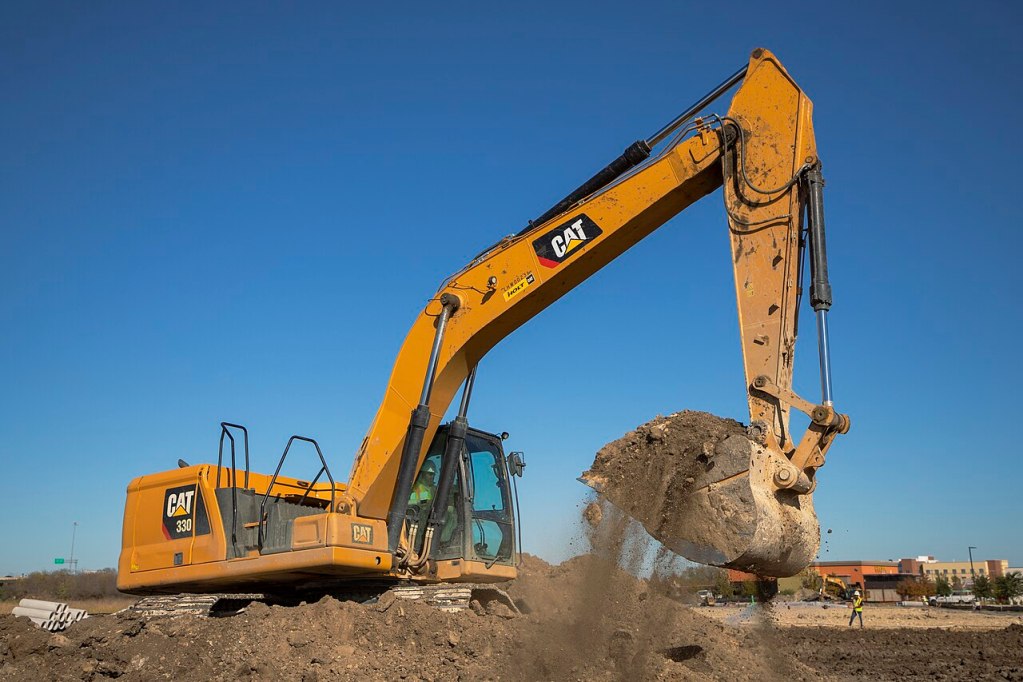
01—Physical AI Gets More Interesting When the Machine Weighs 30 Tons
AI in robotics is easy to demonstrate on a small platform.
A robot dog walks through a room.
A humanoid picks up a box.
A mobile robot follows a route.
Heavy industry is different.
Construction sites change constantly.
Machines operate around people, vehicles, dust, mud, slopes, temporary structures and unfinished terrain.
The cost of a bad decision is much higher.
That is why Caterpillar’s new collaboration with FieldAI is interesting.
The goal is not simply to make one excavator autonomous.
It is to test whether a general-purpose autonomy layer can work across complex industrial environments and multiple types of machines.
02—Caterpillar Announced the Collaboration on September 2
Caterpillar announced the FieldAI collaboration on September 2, 2026.
The companies say they will work together on physical AI, autonomy, robotics and digital twins.
Caterpillar brings heavy-industry engineering, operational knowledge and data from real jobsites and manufacturing environments.
FieldAI brings robot foundation models and autonomy software designed for unstructured environments.
NVIDIA technologies provide part of the simulation and accelerated-computing layer.
The collaboration is early.
Caterpillar has not announced a specific autonomous excavator, loader or truck product tied to the deal.
The announcement is about a technology direction and development partnership.
03—FieldAI’s Main Claim Is One Brain Across Many Robots
FieldAI describes its platform as a general-purpose robot brain.
The company’s Field Foundation Models are designed to work across different robot embodiments rather than being built around one fixed machine.
That is a large claim.
Industrial robotics has historically been highly machine-specific.
A system is configured for one arm.
One vehicle.
One sensor arrangement.
One environment.
FieldAI wants to move toward a shared autonomy layer that can transfer more knowledge across platforms.
If that works, adding autonomy to a new machine could become less like writing a new control stack from zero and more like adapting a common intelligence layer.
04—Robot-Agnostic Does Not Mean Hardware-Agnostic
The phrase robot-agnostic needs a careful interpretation.
A foundation model cannot ignore physics.
An excavator does not move like a quadruped.
A wheeled inspection robot does not have the same sensing or control limits as a haul truck.
Actuators differ.
Mass differs.
Braking distance differs.
Sensor placement differs.
Safety envelopes differ.
The useful meaning of robot-agnostic is that the higher-level autonomy architecture can be reused across embodiments while lower-level interfaces and constraints remain machine-specific.
The model may share reasoning and perception.
The machine still keeps its own physics.
05—FieldAI Builds Around Uncertainty, Not Perfect Maps
Traditional autonomy often depends on structured assumptions.
Known maps.
Defined lanes.
Preplanned routes.
Controlled environments.
FieldAI positions its system around the opposite problem.
Construction and industrial sites change.
A path that existed yesterday may be blocked today.
Material piles move.
Temporary barriers appear.
People enter the scene.
Lighting changes.
The company says its Field Foundation Models combine data-driven AI with physics-based reasoning and uncertainty awareness.
The goal is to let robots operate when the world cannot be perfectly preprogrammed.
06—A Belief World Model Is the Core of FieldAI’s Current Architecture
FieldAI describes its EDGE platform around a Belief World Model.
The concept is that the robot maintains an internal representation of what it thinks is happening in the environment and how uncertain those beliefs are.
That matters because robots never observe the physical world perfectly.
A camera can be blocked.
LiDAR can have incomplete coverage.
A moving object may disappear behind equipment.
The system has to reason about partial information.
Risk-aware autonomy is less about pretending uncertainty does not exist and more about making uncertainty part of the decision process.
07—Heavy Equipment Makes Risk Awareness Essential
A lightweight indoor robot can often stop quickly.
Heavy equipment cannot.
Momentum matters.
Blind spots matter.
Terrain matters.
A machine may need several meters to stop safely.
That means perception confidence cannot be treated as an abstract model score.
Uncertainty has physical consequences.
If the autonomy stack is unsure whether an area is clear, the safest action may be to slow down, stop or request human input.
That is why risk-aware modeling is more meaningful in heavy industry than a generic claim that a model can “see” the environment.
08—The First Applications Are Not Full Autonomous Earthmoving
Caterpillar lists four early application areas.
Autonomous inspection.
Digital twins.
Situational awareness.
Operational optimization.
That list is revealing.
The first value does not require a machine to perform every construction task without a human.
Inspection alone can be valuable.
A robot can repeatedly capture site conditions.
A digital twin can update from those observations.
AI can identify changes or risks.
Simulation can test better workflows.
This is a more practical path than jumping directly to full autonomy.
09—Autonomous Inspection Is the Lowest-Risk Entry Point
Inspection is one of the strongest early use cases for physical AI.
A robot can travel through a site and collect visual, depth and other sensor data.
It can revisit the same areas repeatedly.
Humans do not have to enter every difficult or hazardous location.
The task is valuable even if the robot never moves a bucket of dirt.
That creates an adoption path.
First, the system observes.
Then it builds trust.
Then autonomy can expand into more consequential actions.
10—Every Inspection Run Can Also Build a Digital Twin
FieldAI’s collaboration with NVIDIA shows how inspection becomes more than inspection.
The company says robots collect multimodal data during normal missions.
Vision.
Depth.
LiDAR.
Other sensors.
That data can be transformed into high-fidelity digital reconstructions using NVIDIA Omniverse technologies.
The result is a digital twin that can evolve as the physical site changes.
A robot performing ordinary work becomes a mobile reality-capture system.
11—A Living Digital Twin Is More Useful Than a One-Time Scan
Traditional digital twins can become stale.
A construction site changes every day.
A factory layout changes.
Equipment moves.
Temporary structures appear.
If the digital model takes weeks or months to rebuild, it may describe a site that no longer exists.
FieldAI argues that robots can update the model continuously as a byproduct of operations.
That turns the digital twin from a project deliverable into an ongoing data layer.
12—The Real-to-Sim Loop Is the More Important NVIDIA Connection
NVIDIA Omniverse is not only being used to make attractive 3D models.
FieldAI describes a real-to-sim pipeline.
Robots operate in the physical world.
Their sensors capture the site.
Omniverse reconstruction tools turn that data into simulation-ready environments.
Those environments can then be loaded into Isaac Sim and Isaac Lab.
Autonomy can be tested against a reconstruction of the real site.
The results can feed back into future deployments.
Real operations create simulation.
Simulation improves the robot.
The robot returns to the real world.
13—That Loop Creates a Data Flywheel
Every deployment can create more training and validation data.
Every site adds different terrain.
Different obstacles.
Different lighting.
Different machine layouts.
Different failure cases.
If that data enters a common model-development pipeline, the autonomy system can improve across deployments.
FieldAI calls this a data flywheel.
The strategic advantage is obvious.
The more industrial environments the system sees, the harder it becomes for a new competitor to reproduce the same diversity of real-world experience.
14—Caterpillar Brings a Different Kind of Scale
FieldAI already deploys robotics systems across industrial environments.
Caterpillar brings another scale entirely.
Construction equipment.
Mining equipment.
Factories.
Dealer networks.
Long-lived machines.
Operational data accumulated across decades.
A partnership with a major equipment manufacturer gives an autonomy company access to use cases that are difficult to reproduce in a robotics lab.
The challenge is also larger.
A technology that works on one inspection robot is not automatically ready for a fleet of heavy machines.
15—Caterpillar Already Has Its Own Autonomy History
Caterpillar is not entering autonomy for the first time.
The company has long deployed autonomous mining systems and machine-control technologies.
That existing background matters.
FieldAI is not replacing an empty stack.
The collaboration adds a newer foundation-model approach to an organization that already understands industrial automation, safety engineering and large-scale equipment operations.
The interesting question is whether general-purpose models can expand autonomy beyond tightly engineered environments.
16—Mining Autonomy Is Easier Than a Chaotic Construction Site in One Important Way
Large mining operations can be highly structured.
Routes can be mapped.
Traffic rules can be controlled.
Access can be restricted.
Machines can operate in managed areas.
Construction sites are often less predictable.
People move through the environment.
Layouts change quickly.
Temporary materials appear.
Multiple contractors work simultaneously.
That makes general autonomy harder.
FieldAI’s value proposition is specifically aimed at those environments where traditional automation becomes expensive to configure or brittle when conditions change.
17—Traditional Automation Is Strongest When the World Stays the Same
Automation works beautifully in repeatable environments.
A factory robot can perform the same motion thousands of times.
A conveyor follows a fixed path.
A machine-vision camera inspects the same product.
The system becomes harder to scale when the world changes faster than engineers can reconfigure it.
Foundation-model robotics is trying to reduce that reconfiguration burden.
Instead of encoding every situation manually, the autonomy system learns broader patterns and adapts.
That promise is powerful.
It is also much harder to validate.
18—Generalization Is the Whole Bet
The economic argument for general-purpose autonomy depends on reuse.
If every new site requires months of custom engineering, deployment does not scale well.
If one model can transfer useful behavior from one environment to another, integration cost can fall.
The model does not have to work perfectly with zero adaptation.
It only has to reduce the amount of machine-specific and site-specific engineering enough to change the economics.
That is what Caterpillar and FieldAI are really testing.
19—Digital Twins Can Make Validation More Site-Specific
A general model creates a safety problem.
How do you know it will behave correctly at this particular site?
Digital twins provide one answer.
Capture the real environment.
Reconstruct it.
Run simulated missions.
Introduce edge cases.
Test routes.
Change layouts.
Evaluate policies before the robot operates physically.
The simulation does not replace real validation.
It gives engineers another layer where failures can be found before they happen around real equipment.
20—Simulation Is Only Useful If It Represents the Hard Parts
A clean synthetic environment is easy to simulate.
Real sites are messy.
Dust.
Debris.
Uneven terrain.
Partial visibility.
Temporary structures.
Dynamic obstacles.
FieldAI’s approach is interesting because the simulation environment begins with data captured from actual deployments.
That can preserve site-specific complexity that a manually built digital twin might miss.
The closer the simulation is to the operating environment, the more useful it becomes for regression testing and scenario analysis.
21—NVIDIA Supplies the Infrastructure, Not the Robot Intelligence
The partnership includes NVIDIA accelerated computing and Omniverse technologies.
The roles should stay clear.
FieldAI provides the autonomy models and robot-intelligence layer.
Caterpillar provides industrial machines, engineering and operational expertise.
NVIDIA provides simulation, reconstruction and computing infrastructure used in the development pipeline.
That three-layer structure matters because physical AI increasingly depends on an ecosystem rather than one company building everything.
22—Operational Optimization May Be Valuable Before Full Autonomy
Caterpillar also lists operational optimization as an early use case.
A digital twin can show how machines, people and materials move through a site.
Simulation can test alternative layouts.
AI can identify bottlenecks.
Maintenance data can be connected to site conditions.
A company may gain meaningful productivity improvements without removing human operators.
That makes physical AI easier to deploy incrementally.
Observation and optimization first.
More autonomous execution later.
23—Situational Awareness Is Another Intermediate Layer
Situational awareness sits between sensing and control.
A robot or machine can identify what is happening around it and surface useful information to people.
Potential hazards.
Blocked routes.
Changing site conditions.
Equipment positions.
Areas that need inspection.
The system does not need authority to perform every action.
It can make the environment more legible to operators and supervisors.
That can improve decision-making while keeping humans inside the control loop.
24—The Human-Machine Boundary Is Part of Caterpillar’s Message
Caterpillar frames the collaboration around combining human expertise with AI-powered machines.
That language matters.
Heavy industry will not switch from human-operated equipment to fully autonomous fleets overnight.
Mixed environments are more likely.
Some machines autonomous.
Some remote-controlled.
Some human-operated.
Robots performing inspections.
AI systems providing recommendations.
Humans handling exceptions and high-consequence decisions.
The hard problem is not only autonomous capability.
It is coordination across all of those modes.
25—A Universal Robot Brain Still Needs Machine-Specific Safety Layers
Even if FieldAI’s model generalizes across platforms, safety cannot be universal in the same way.
A large articulated truck has different stopping behavior from a small quadruped.
An excavator has a rotating upper structure and a large working envelope.
A robotic arm has joint limits and collision zones.
Each machine needs hard constraints close to the control layer.
The foundation model can choose a goal.
The equipment still needs deterministic limits on what is physically allowed.
26—This Is Where Physical AI Differs From Software Agents
A software agent can make a mistake and often retry.
A physical machine may not get a second chance.
A collision cannot be undone.
A slope failure cannot be rolled back.
A person entering a machine path changes the risk instantly.
That makes uncertainty calibration, fail-safe behavior and verification central to industrial autonomy.
The model cannot simply be impressive.
The complete system has to be predictable enough to earn operational trust.
27—FieldAI Says It Already Operates Across Hundreds of Sites
FieldAI says its technology has been tested and deployed across hundreds of complex industrial environments.
The company also says its deployments span multiple continents and several robot types.
Those are company-reported deployment claims.
They are useful because they show the technology is beyond a single laboratory demo.
They should not be converted into an independent measure of reliability.
Scale of deployment is not the same thing as verified safety performance.
28—The Company Has Raised More Than $400 Million
FieldAI announced in 2025 that it had raised $405 million across two funding rounds.
Its investor list includes major venture and strategic investors.
That capital gives the company resources to build expensive robotics infrastructure, collect field data and support deployments.
Physical AI is capital intensive.
Models need data.
Robots need hardware.
Sites need integration.
Safety testing takes time.
A large funding base matters because the product has to survive the gap between a research result and an industrial platform.
29—The Caterpillar Partnership Is More Important Than a Humanoid Demo
Robotics headlines often focus on humanoids because they are visually striking.
Caterpillar’s partnership points toward a different future.
The most valuable robot may be the machine already designed for the job.
An excavator already has the right body for digging.
A haul truck already has the right body for moving material.
A quadruped may be better for inspection.
The autonomy layer does not need every robot to look human.
It needs to understand enough different embodiments to use the right machine for each task.
30—Embodiment-Agnostic AI Could Reduce the Pressure to Build One Universal Robot
The idea of one humanoid doing everything is attractive because it simplifies the hardware story.
One body.
Many tasks.
FieldAI is pursuing another kind of universality.
Many bodies.
One higher-level intelligence architecture.
That may fit industrial reality better.
Factories and jobsites already contain specialized machines.
Replacing all of them with humanoids would be expensive and often unnecessary.
Adding a reusable autonomy layer to existing machine categories could be a faster route to general-purpose physical AI.
31—The Real Product May Become the Autonomy Layer
If robot intelligence becomes portable, the strategic value shifts.
The robot body becomes one part of the system.
The autonomy layer carries perception, world modeling, planning, risk reasoning and learned experience.
That starts to resemble what operating systems did for computers.
Different hardware.
A common software layer.
Robotics is not there yet.
But Caterpillar working with a company that explicitly describes itself as one brain for many robots shows where the industry wants to go.
32—What Caterpillar and FieldAI Have Actually Confirmed
Caterpillar and FieldAI announced a collaboration on September 2, 2026.
The companies say they will work on physical AI, robotics, autonomy and digital twins for complex jobsites and manufacturing environments.
Caterpillar lists autonomous inspections, site and facility digital twins, enhanced situational awareness and operational optimization as early application areas.
The collaboration combines Caterpillar’s industry expertise and operational data with FieldAI’s robot-agnostic foundation models.
The companies also say NVIDIA accelerated computing and Omniverse technologies will support the work.
FieldAI describes its models as combining data-driven AI, physics-based reasoning and uncertainty awareness.
No specific fully autonomous Caterpillar production machine was announced as part of the release.
33—What We Should Not Claim
We should not say Caterpillar has launched a fully autonomous excavator powered by FieldAI.
It has not announced that.
We should not say one FieldAI model already controls every Caterpillar machine.
The collaboration is broader and earlier than that.
We should not treat robot-agnostic as meaning the physical differences between machines disappear.
We should not claim the system eliminates human operators.
Caterpillar explicitly frames the work around human expertise and AI-powered machines.
We should not turn FieldAI’s deployment scale into an independent reliability statistic.
And we should not claim digital twins prove real-world safety.
Simulation is one validation layer, not a substitute for physical testing.
34—The Bigger Shift Is From Autonomous Machines to Portable Autonomy
The first generation of industrial autonomy was machine-specific.
One autonomous haul truck.
One warehouse robot.
One programmed arm.
Caterpillar and FieldAI are testing a more ambitious idea.
Build an autonomy layer that can move between machines, learn from many sites and use the physical world itself to improve simulation and validation.
If that works, the important product is no longer one autonomous machine.
It is portable autonomy.
A common intelligence layer that can understand enough about different machines to make more of the industrial world programmable.
That is a much bigger shift than putting AI inside an excavator.