
01—A Lot of Modern Science Runs on Code That Was Never Designed to Last
Scientific software has an unusual lifecycle.
A graduate student writes a script for a paper.
A lab turns it into a package.
Other researchers begin using it.
Years pass.
Python changes.
Dependencies break.
Build systems change.
GPU libraries change.
The original author moves on.
The tool is still scientifically useful, but the engineering around it starts to decay.
OpenAI’s July 2026 field report argues that this maintenance gap is one of the places where coding agents may be unusually valuable.
The report is not mainly about agents discovering new science.
It is about agents repairing, porting, optimizing and rebuilding the software that existing science already depends on.
02—OpenAI Studied Eight Real Scientific-Computing Projects
The report covers eight agent-assisted coding projects, concentrated mainly in computational biology and other data-heavy scientific work.
Five projects used Codex alone.
Three used a combination of Codex and Claude Code.
The projects were deliberately varied.
One modernized packaging and build infrastructure.
Another rewrote a mature machine-learning backend.
Others translated large systems into Rust, optimized genome assembly code, consolidated quality-control workflows and built a GPU-native scientific pipeline.
OpenAI describes the work as an exploratory field report rather than a controlled benchmark study.
That distinction matters.
The case studies show what happened in specific projects.
They are not a universal performance score for coding agents.
03—The Common Problem Was Not Lack of Scientific Ideas
The scientists in these projects generally knew what they wanted.
The bottleneck was engineering effort.
Scientific code often sits in an awkward middle ground.
It may be too specialized for a commercial software team to maintain.
It may also be too important to abandon.
Researchers therefore spend time on packaging, compatibility, performance, build systems and debugging instead of on the scientific questions that motivated the software.
OpenAI’s report frames coding agents as a way to reduce that fixed engineering cost.
If the repetitive implementation work becomes cheaper, a small research team can attempt modernization projects that previously looked too expensive or too time-consuming.
04—cyvcf2 Is the Smallest Example — and One of the Most Important
The cyvcf2 case is not glamorous.
That is exactly why it matters.
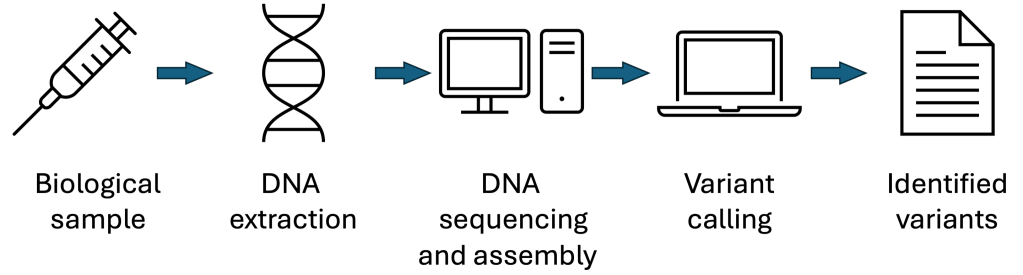
cyvcf2 is a Python library used to read and write VCF files, a standard format for genomic variants.
Over more than a decade, Python changed dramatically.
Packaging systems changed.
Continuous integration changed.
The library accumulated maintenance complexity.
The case study used a coding agent to modernize packaging, testing and release infrastructure.
The major refactor moved the project toward a newer build system using scikit-build-core.
The change was ultimately merged.
The scientific behavior was not supposed to change.
The goal was to make an old but useful tool easier to install, test and release.
05—The Agent Was Useful Because There Was a Test Suite
The cyvcf2 case contains one of the clearest lessons in the report.
The maintainers could trust a large build-system change because they had tests and continuous integration.
The agent could recommend a modern packaging approach.
It could implement it.
Other agents could review it.
But confidence came from the ability to compare the modified package against expected behavior.
Without that test infrastructure, the team says it would have been difficult to evaluate the consequences of the change.
That turns testing into more than ordinary software hygiene.
Testing becomes the interface between agent speed and scientific trust.
06—MHCflurry Shows Agents Can Handle a Much Larger Migration
Another case study was much more invasive.
MHCflurry had a neural-network backend built on an aging TensorFlow and Keras stack.
The team wanted to move the system to PyTorch while preserving existing models and predictions.
According to the report, Claude Code and Codex worked in alternating contributor and reviewer roles.
The migration changed nearly 10,000 lines across roughly 130 files.
Previously released weights still had to load.
Predictions still had to agree within defined tolerances.
The result shipped as MHCflurry 2.2.0.
The impressive part is not simply the number of changed lines.
It is that the migration had a defined equivalence target.
07—A Rewrite Is Easy to Demo and Hard to Validate
Replacing one framework with another can produce code that looks correct very quickly.
That is not enough.
Numerical software can fail in subtle ways.
A default changes.
A tensor is cast differently.
A reduction runs in a different order.
An edge case is silently skipped.
The output can still look plausible.
That is why the report repeatedly returns to validation.
The MHCflurry team compared predictions between old and new backends.
Other projects used byte-identical output, known simulated answers, held-out datasets or statistical diagnostics.
The agents wrote code quickly.
Humans had to decide what evidence would count as proof that the code still meant the same thing scientifically.
08—rustar-aligner Tried Something Even Riskier: Rewriting Mature C++ Behavior in Rust
One project attempted to replace STAR, a widely used RNA-sequencing aligner, with a Rust implementation called rustar-aligner.
STAR contains more than 20,000 lines of accumulated C and C++ behavior.
The challenge was not merely translating syntax.
The replacement had to reproduce reference-index construction, read alignment, scoring, multimapping behavior, output formatting and command-line behavior.
The case study reports very high agreement with STAR on a yeast RNA-seq workload.
That is a striking example of agent-assisted reimplementation.
It is also a warning.
Mature scientific tools accumulate undocumented behavior.
A new implementation can be cleaner and still be wrong in ways users care about.
09—Getting From 90% to the Last Few Percent Was the Hard Part
OpenAI’s report repeatedly describes a “last mile” problem.
Agents often produced a first implementation quickly.
Then the difficult work began.
Edge cases appeared.
Numerical differences appeared.
Real datasets exposed behavior that small tests missed.
In rustar-aligner, progress beyond roughly 90% parity required tracing individual reads through both implementations to understand discrepancies.
That pattern matters for anyone expecting autonomous scientific software development.
The first 80 or 90% can be visually impressive.
The last few percent may contain the scientific correctness.
10—RustQC Shows Why Performance Optimization Can Be a Scientific Contribution
Scientific pipelines often process enormous datasets repeatedly.
A small inefficiency can become expensive when multiplied by millions of files or billions of records.
The RustQC case consolidated multiple post-alignment quality-control tasks into a single-pass Rust workflow.
In one case-study benchmark on a 186-million-read dataset, the reported summed sequential runtime fell from 15 hours 34 minutes to 14 minutes 54 seconds.
Disk traffic fell from 2.5 TB to 0.1 TB.
The report describes that as more than a 60-fold runtime reduction for the tested workflow.
Those figures are contributor-reported case-study outcomes.
They are not a universal “Codex makes science 60× faster” result.
11—Faster Code Can Change Which Experiments Are Practical
Performance work is easy to dismiss as engineering polish.
In data-intensive science, it can change the research boundary.
A workflow that takes fifteen hours may be run occasionally.
A workflow that takes fifteen minutes can be run repeatedly during iteration.
Lower disk traffic can make large-scale analysis cheaper.
A faster pipeline can make more replicates, more parameter sweeps or more quality checks practical.
This is where scientific software engineering affects discovery indirectly.
The agent is not deciding which biological hypothesis is true.
It is reducing the computational friction around testing hypotheses.
12—HelixForge Is the Most Aggressive Example in the Report
HelixForge was built as a GPU-native system for generating synthetic genome data with known inserted mutations.
The existing CPU workflow launched several external tools for each mutation and then remapped edited reads.
The project replaced much of that workflow with a custom htslib and CUDA C++ engine running on an NVIDIA H200 GPU.
The case study reports an editing-stage speedup of about 98.6× and an end-to-end speedup of about 59.6× on its matched benchmark.
It also reports improvements in some measured mutation-quality metrics.
Those results are impressive.
The report is careful to describe them as a focused case-specific engineering comparison, not exhaustive validation across every donor or genome.
13—The Humans Designed the Experiment Before the Agents Optimized It
The HelixForge case makes the human role unusually explicit.
The research team defined the scientific objective.
They identified known failure modes.
They specified validation criteria.
They decided the order in which the system should be rebuilt.
They first stabilized a CPU reference.
Only then did they move toward the GPU-native engine.
The agents handled much of the implementation, CUDA iteration, source review and validation-harness development.
That division of labor is important.
The agent accelerated execution.
The humans decided what a valid scientific comparison looked like.
14—Even the Validation Harness Can Be Wrong
One of the best lessons in the report comes from a failure.
During HelixForge development, an early strand-balance audit produced a false positive because of the downsampling procedure.
The agent responded by modifying the GPU implementation.
But the implementation was not the problem.
The test was.
This is a critical point for agentic science.
A model can optimize against a bad metric very efficiently.
If the acceptance test is wrong, faster iteration can move the project in the wrong direction faster.
Humans therefore have to validate both the software and the system used to judge the software.
15—hifiasm Shows That Real Data Can Shrink Benchmark Gains
Another project optimized hifiasm, software used for genome assembly.
The agents focused on hot paths such as read correction, edit-distance computation, trace generation and overlap chaining.
The case study reports a 25.1% runtime reduction on held-out synthetic data.
On recorded human chromosome 20 reads, the reduction was 14.7%.
The direction remained positive.
The magnitude changed.
That difference is exactly why scientific performance claims need real workloads.
Synthetic benchmarks are useful.
They are not always representative.
OpenAI’s report explicitly highlights this gap.
16—HI.SIM Was the Exception: Almost No Human Intervention After the Prompt
Seven of the eight contributions kept humans deeply involved in validation and orchestration.
HI.SIM was the exception.
The task was a targeted optimization with an unusually clean acceptance criterion: preserve byte-identical output.
The agent removed repeated calculations, unnecessary memory allocation and small write overheads.
The case study reports a 30.97% aggregate runtime reduction across four benchmark workloads.
Because correctness could be expressed as exact output identity, the agent had a much clearer target.
This suggests that agent autonomy increases when success is measurable in a simple and objective way.
17—The Harder the Scientific Meaning, the More Humans Had to Stay Involved
Not every scientific program has a byte-identical reference.
A new statistical method may produce a distribution rather than one exact answer.
A new simulator may need to preserve physical behavior rather than file bytes.
A GPU rewrite may intentionally change internal algorithms while preserving scientific outputs.
The report finds that human validation burden generally increased as the change affected more of the software and altered more scientific behavior.
That relationship is intuitive.
Agents are strongest when the task is clear and the acceptance test is objective.
Scientific judgment becomes more important as the target becomes ambiguous.
18—Plausible Output Is Weak Evidence
This is probably the most important sentence in the report’s validation discussion:
Compilation and plausible-looking output are weak evidence of correctness.
Scientific code can produce reasonable-looking numbers while being subtly wrong.
The authors observed changed numerical defaults, inappropriate memory behavior, silently skipped cases and other errors.
Some statistical extensions initially produced plausible aggregate behavior but failed deeper convergence or simulation-based checks.
That is the difference between software that runs and software that can be trusted scientifically.
Coding agents dramatically lower the cost of producing the first.
They do not automatically produce the second.
19—The Researcher’s Role Moves From Typing to Orchestration
Across the case studies, contributors described a shift in their own work.
Less time was spent implementing every line manually.
More time was spent deciding what should be built.
Breaking the problem into smaller tasks.
Designing benchmarks.
Interpreting discrepancies.
Reviewing edge cases.
Deciding whether the evidence was sufficient to ship.
OpenAI compares this emerging role to product management in some parts of the report.
For scientific work, the phrase may be even stronger.
The researcher becomes the owner of the scientific contract.
The agent can implement.
The human defines what correctness means.
20—Agents Lower the Cost of Rewriting — Which Creates a New Risk
If rewriting old scientific software becomes cheap, researchers may create many parallel replacements.
That sounds healthy.
It can also fragment a community.
Mature tools accumulate trust, documentation, conventions and users.
A technically cleaner rewrite may split attention instead of improving the original ecosystem.
The report warns that cheaper implementation does not remove the need for stewardship.
Someone has to maintain the new tool.
Someone has to answer bug reports.
Someone has to decide whether the rewrite replaces the old project, merges into it or remains experimental.
Without ownership, today’s AI modernization can become tomorrow’s abandoned code.
21—Merging Back Into Existing Projects Was Often the Better Outcome
The report points to several different stewardship outcomes.
Changes to cyvcf2 and MHCflurry were merged into the original projects.
rustar-aligner moved toward new community stewardship after the original project had been abandoned.
Those paths are different, but they share one principle.
The software needs an owner after the agent finishes.
That is a useful corrective to the idea that code generation is the end of software development.
In science, long-term credibility often depends more on maintenance than on the first successful build.
22—The Report Is Exploratory, Not a Controlled Agent Benchmark
OpenAI explicitly says the report is exploratory and retrospective.
The case studies were written by the groups that conducted the work.
OpenAI standardized their organization, checked internal consistency and selected public artifacts where feasible.
It did not independently reproduce every benchmark or validate every reported project result.
That means numbers such as 60×, 98.6×, 25.1% or 30.97% should be read as contributor-reported outcomes under specific case-study conditions.
They are valuable evidence.
They are not direct comparisons proving one model or one agent setup is generally superior.
23—The Bigger Opportunity Is Scientific Software That Stays Runnable
Scientific reproducibility depends on more than publishing a paper.
Another researcher has to install the code.
The dependencies have to resolve.
The tool has to run on current hardware.
Its documented workflow has to still work.
OpenAI’s report cites earlier studies showing how often published research code fails basic reuse.
That maintenance gap quietly wastes scientific time.
If coding agents can make packaging, migration and performance work cheaper, one of their most valuable scientific contributions may be boring by design.
Keeping existing tools alive.
24—What OpenAI’s Report Actually Supports
OpenAI’s field report supports several concrete conclusions.
Coding agents were used across eight scientific-computing projects, mainly in life-science software.
Five projects used Codex alone and three combined Codex and Claude Code.
The work ranged from packaging maintenance to broad rewrites and GPU-specific redesigns.
Contributors consistently reported that well-scoped implementation tasks were a strong use case.
They also reported that validation, scientific judgment and project stewardship remained human responsibilities.
Several projects shipped or merged their changes.
The report also documents large case-specific performance improvements in some workloads.
OpenAI does not claim those outcomes are universal or independently replicated agent benchmarks.
25—What We Should Not Claim
We should not say Codex independently modernized all eight projects.
We should not say the agents determined scientific correctness themselves.
We should not convert a 60× RustQC case result into a general Codex speedup.
We should not present the HelixForge 98.6× editing-stage result as an exhaustive benchmark across all genomic workloads.
We should not claim every project required less human effort at every stage.
We should not say agents eliminate the research-software maintenance problem.
And we should not treat OpenAI’s field report as a controlled benchmark comparing Codex against human engineers.
The report is more useful than that.
It shows what early teams actually tried, where agents helped and where the work still became difficult.
26—The Next Scientific Bottleneck May Be Verification, Not Implementation
Coding agents make implementation cheaper.
That changes which part of the workflow becomes scarce.
If ten times more scientific software can be rewritten, someone still has to validate it.
If optimization becomes easier, researchers need stronger benchmark design.
If new statistical methods can be implemented rapidly, scientists need better tests for whether those methods behave correctly.
The bottleneck moves.
That is the deeper message in OpenAI’s report.
AI does not remove scientific labor.
It moves human effort away from typing every implementation detail and toward the parts where judgment matters most.
What should be built?
How do we know it is right?
Who will maintain it?
Those may become the defining questions of agentic scientific computing.