
01—Closed-Loop Liquid Cooling Is Becoming Part of the AI Compute Stack
AI infrastructure is usually described through processors, memory and networks.
Cooling is now moving into the same architectural conversation.
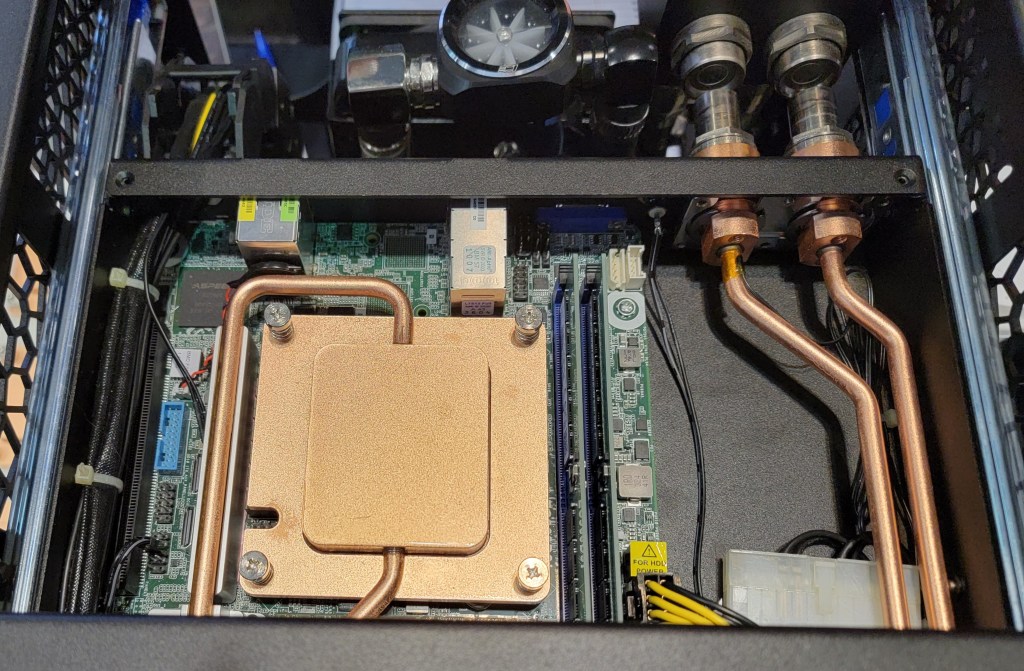
Meta’s newest AI-optimized data centers use direct-to-chip closed-loop liquid cooling as part of the facility design. The coolant moves heat away from high-density compute hardware, passes through heat exchangers and then returns to the racks in a continuous loop.
That makes the cooling system part of the compute platform rather than a separate room-level utility.
A GPU rack has a power envelope.
That power becomes heat.
The cold plates, coolant flow, pumps, heat exchangers and external heat-rejection system have to be sized around that heat before the rack can operate at its intended density.
Meta described this shift in detail on August 27, 2026.
The company uses a water-and-glycol coolant mixture in closed loops and says the same coolant can remain in service for up to a decade.
The important change is architectural.
Compute density now influences plumbing design.
Plumbing design influences rack layout.
Rack layout influences the building.
Cooling has become another layer of the AI stack.
02—Power Density Connects Compute Design Directly to Thermal Design
Every watt consumed by a processor eventually becomes heat that has to leave the system.
That relationship becomes more visible as AI racks concentrate larger amounts of compute into a small physical area.
Meta’s infrastructure team previously described a six-rack pod in which two compute racks contained 72 NVIDIA Blackwell GPUs and consumed about 140 kilowatts.
The surrounding pod used four Air-Assisted Liquid Cooling racks to support that deployment in a traditional data-center environment.
The example shows how thermal architecture follows compute density.
The GPUs define the workload capacity.
Power delivery supplies the electrical energy.
The cooling system removes the resulting heat.
Networking keeps the accelerators connected.
All four systems have to fit into the same physical design.
That is why cooling is becoming a first-order infrastructure parameter.
A data-center team planning a new AI system cannot choose compute density first and treat heat removal as an unrelated decision later.
The two are connected from the beginning.
03—Direct-to-Chip Cooling Moves the Thermal Path Closer to the Processor
Direct-to-chip liquid cooling shortens the thermal path.
A cold plate sits directly on a high-power component such as a CPU or GPU.
Heat moves from the silicon package into the cold plate.
Liquid flowing through channels inside that plate carries the heat away.
The coolant then moves through the rack-level or facility-level loop toward a heat exchanger.
This is different from cooling only the surrounding room air.
The liquid interacts with the component through a dedicated thermal interface.
The Open Compute Project’s Cold Plate Sub-Project describes direct liquid cooling as an ecosystem extending from the cold plate through the technology cooling system and coolant distribution unit.
That framing is useful because the cold plate is only the first piece.
Tubing, quick disconnects, manifolds, pumps, sensors, filtration, coolant chemistry and heat exchangers all become part of the same thermal path.
The cooling architecture therefore begins on the processor and continues through the rack and the facility.
04—Meta Uses a Water-and-Glycol Coolant in a Sealed Loop
Meta describes its current closed-loop design as circulating a mixture of water and glycol.
The coolant repeatedly travels through the compute equipment, absorbs heat and then moves toward the heat-exchange stage.
After the heat is transferred away, the cooled liquid returns to the racks.
The same fluid circulates again.
That is the meaning of the closed loop.
The coolant is not continuously consumed as part of the ordinary thermal cycle.
Meta says it expects the coolant used in these loops to remain in service for up to ten years before replacement.
The glycol component gives the fluid system properties suitable for long-term thermal operation, including protection across environmental conditions.
The exact coolant formulation and facility design can vary.
The important architectural feature is recirculation.
The thermal loop carries energy away from the chips while the working fluid remains inside the system.
05—Heat Exchangers Separate the Compute Loop From Heat Rejection
The coolant has to release the heat it collected from the processors.
That happens through heat exchangers.
A heat exchanger allows thermal energy to move from one fluid or system to another without requiring the two circuits to become one shared loop.
This creates a useful boundary.
The technology cooling system can circulate coolant through the racks.
The facility side can then move that heat toward dry coolers or another site-specific heat-rejection system.
Meta’s typical new data-center design uses direct-to-chip closed-loop cooling with dry coolers where local conditions support that approach.
The coolant therefore handles the internal transport.
The heat exchanger hands the thermal load to the facility.
The dry cooler rejects the heat to the outside environment.
This layered structure keeps the processor-side thermal loop and the larger building system connected while allowing each part to perform a different job.
06—Dry Coolers Let the Facility Reject Heat Without Consuming the Rack Coolant
Meta says many of its closed-loop sites use dry coolers.
A dry cooler moves outdoor air across heat-exchange surfaces to remove energy from the closed liquid system.
The rack coolant stays inside the loop.
The outside air does not mix with it.
Meta’s water-stewardship documentation says its typical direct-to-chip closed-loop design with dry coolers has no operational water use in the cooling system itself, with site water use limited to other facility needs such as domestic use, cleaning and fire protection.
That statement applies to the specific design Meta describes.
Other data centers can use different cooling architectures depending on climate, site resources and equipment.
The important point for the AI compute stack is that heat rejection can be designed as a separate facility stage.
The chips transfer heat to coolant.
The coolant transfers heat through the exchanger.
The facility rejects that heat outdoors.
Each layer has its own interface.
07—Cold Plates Are Becoming a Standardized Hardware Interface
As direct-to-chip cooling becomes more common, the industry is also standardizing the components that connect to the processors.
The Open Compute Project’s Cold Plate Sub-Project is developing specifications and guidelines for direct liquid cooling.
Its work covers cold plates, connectors, hose routing, coolant loops and coolant distribution systems.
The project describes its goal as enabling an open ecosystem for direct liquid cooling.
That matters because cooling hardware is beginning to look more like the rest of data-center infrastructure.
Interfaces can be specified.
Flow requirements can be documented.
Connector designs can be standardized.
Coolant compatibility can be tested.
A server vendor, cooling supplier and data-center operator can then design around a shared set of engineering expectations.
Thermal infrastructure becomes a platform with interfaces, not only custom plumbing built independently for each deployment.
08—Coolant Distribution Units Manage Flow Between the Facility and the Rack
A Coolant Distribution Unit, or CDU, is another important layer.
The CDU manages the liquid flow serving the IT equipment.
Depending on the design, it can contain pumps, heat exchangers, sensors, filtration and control hardware.
The facility side supplies one thermal condition.
The CDU creates the controlled loop needed by the rack.
The rack manifold then distributes coolant to individual servers or cold plates.
This gives operators another boundary in the cooling architecture.
Facility water or facility heat-rejection equipment does not need to connect directly to every processor cold plate.
The CDU can isolate and manage the technology cooling system in between.
Open Compute Project specifications treat the CDU as part of the direct-liquid-cooling ecosystem.
That makes it similar to a power-distribution layer.
Electric power moves through conversion and distribution stages before it reaches the processor.
Cooling can now move through heat-exchange and distribution stages before it reaches the same processor.
09—Air-Assisted Liquid Cooling Lets Liquid-Cooled Hardware Enter Existing Facilities
Not every data center was originally built with facility liquid loops.
Meta uses Air-Assisted Liquid Cooling, or AALC, for some of those environments.
AALC places pumps and heat exchangers near the racks.
The liquid loop cools the high-density hardware.
The AALC system then transfers the heat into the facility’s existing air-based environment.
This creates a bridge between newer liquid-cooled equipment and buildings designed around a different thermal architecture.
Meta used AALC with its Blackwell deployment in traditional data centers and has described it as a smaller, distributed version of the closed-loop concept.
The core thermal idea remains the same.
Liquid collects heat close to the processors.
A heat exchanger moves that energy into the next cooling stage.
The difference is where that transfer happens.
This lets cooling architecture evolve in stages instead of requiring every facility to use exactly the same building-level loop.
10—Cooling Capacity Influences How Much Compute Fits Into a Rack
Thermal design also changes physical density.
Meta says cooling the same high-density AI hardware entirely through larger air-handling structures could require substantially more tray space in the example it describes.
Liquid cooling moves much of the thermal transport into cold plates and tubing.
That can leave more of the rack volume available for compute, memory, networking and power hardware.
The relationship is simple.
A rack has finite dimensions.
Every fan, heat sink, duct, manifold and cable consumes space.
The cooling method changes how that space is allocated.
As AI hardware concentrates more electrical power per rack, thermal hardware becomes part of the density equation.
Compute density is therefore not only a semiconductor metric.
It is a mechanical and facility metric too.
The number of accelerators that can operate in one rack depends on whether the rack can receive enough power and remove enough heat.
11—Cooling Loops Are Designed for Long Service Life
A data-center cooling loop is infrastructure, not a disposable accessory.
It has to operate continuously across long deployment cycles.
Meta says the water-and-glycol mixture in its closed-loop system is expected to remain in service for up to a decade.
Open Compute Project work on direct-to-chip cooling also includes coolant chemistry, corrosion, material compatibility, filtration, connectors and long-term loop requirements.
Those subjects matter because the cooling fluid touches metals, seals, hoses and heat-exchange surfaces across the system.
The thermal performance of the loop has to remain predictable over time.
The mechanical interfaces also have to support maintenance and replacement of IT equipment.
This creates a lifecycle engineering problem.
A GPU generation may change quickly.
The cooling infrastructure around it is expected to support several equipment cycles.
That gives thermal standards another role: help make the rack and facility useful across successive generations of compute hardware.
12—Cooling Operations Are Becoming Sensor-Driven
A closed-loop system is also a control system.
Operators can measure coolant temperature.
Flow rate.
Pressure.
Rack inlet and outlet conditions.
Heat-exchanger behavior.
Pump state.
Server load.
Outside weather.
Those measurements can be used to change cooling operation dynamically.
The workload is not constant.
Training jobs can move.
Inference traffic can rise and fall.
Outdoor temperature changes through the day and across seasons.
The cooling system therefore has to respond to changing thermal demand.
This makes data-center cooling increasingly similar to other automated infrastructure.
Sensors provide state.
Controllers choose operating points.
The facility changes fan speeds, pump behavior or other control settings.
Cooling becomes software-addressable infrastructure built around a physical thermal loop.
13—Meta Is Using Reinforcement Learning to Optimize Cooling Control
Meta is also applying AI to the operation of its cooling systems.
The company says its engineering teams built a physics-based simulator that models weather conditions, server load and cooling-equipment behavior.
A reinforcement-learning system can test control decisions inside that simulated environment before policies are applied to the real facility.
Meta says the approach has been scaled to air-cooled data centers in its fleet.
In one pilot, Meta reports that the reinforcement-learning approach reduced supply-fan energy consumption by an average of 20 percent while reducing water usage by 4 percent across varying weather conditions.
Those are Meta’s pilot results for the specific facility and control system it tested.
The architectural point is broader.
Cooling is no longer only a fixed mechanical design.
Its operating policy can also be optimized by software.
The AI compute stack produces heat.
AI can then participate in controlling the infrastructure that removes that heat.
14—Liquid Cooling Is Becoming an Industry Standards Problem
The move toward higher-density liquid cooling is larger than one data-center operator.
The Open Compute Project and ASHRAE formed an alliance in 2025 focused on liquid-cooling standards and best practices for AI data centers.
Their joint scope spans facility water systems, technology cooling systems, direct-to-chip equipment, immersion cooling and coolant distribution units.
That is a sign that thermal management is becoming an interoperable infrastructure discipline.
Facilities need terminology.
Equipment classes.
Temperature ranges.
Flow requirements.
Connector definitions.
Fluid guidance.
Testing methods.
As those elements become standardized, AI hardware vendors and data-center operators can design around shared thermal interfaces.
Cooling starts to resemble power and networking.
It becomes a layer that needs formal specifications because many independent systems have to connect to it.
15—New AI Data Centers Are Being Designed Around Liquid Cooling From the Beginning
Meta’s infrastructure plans show the difference between adaptation and native design.
Traditional facilities can use Air-Assisted Liquid Cooling to support newer equipment.
New AI-optimized facilities can include direct-to-chip closed loops in the original building architecture.
That changes planning.
Pipe routing is designed with the data hall.
Heat exchangers are sized with the compute plan.
Dry coolers are selected with the local climate.
Rack density is coordinated with power delivery.
Mechanical systems are designed around the expected thermal load.
Meta says it chooses cooling technologies based on local conditions, including climate, resource availability and technical requirements.
The result is not one identical cooling design for every site.
It is a facility architecture where cooling is chosen alongside compute rather than added after the compute platform is finalized.
16—The AI Compute Stack Now Extends From Silicon to Heat Rejection
The modern AI stack can be traced through several physical layers.
The model runs on accelerators.
Memory feeds the accelerators.
Networks connect them.
Power systems deliver electrical energy.
Cold plates collect the resulting heat.
Coolant carries that heat through the rack.
CDUs and heat exchangers move it into the facility system.
Dry coolers or other site-specific infrastructure reject it to the environment.
Sensors measure the system.
Control software adjusts operation.
Meta’s closed-loop deployments show how those layers now have to be designed together.
The cooling system is not separate from compute capacity.
It helps define the compute capacity that can operate in a given rack and building.
That is why closed-loop liquid cooling is becoming part of the AI compute stack.
The processor creates the work.
The thermal system makes sustained operation possible.
The two are now designed as one infrastructure problem.
That is the upgrade.